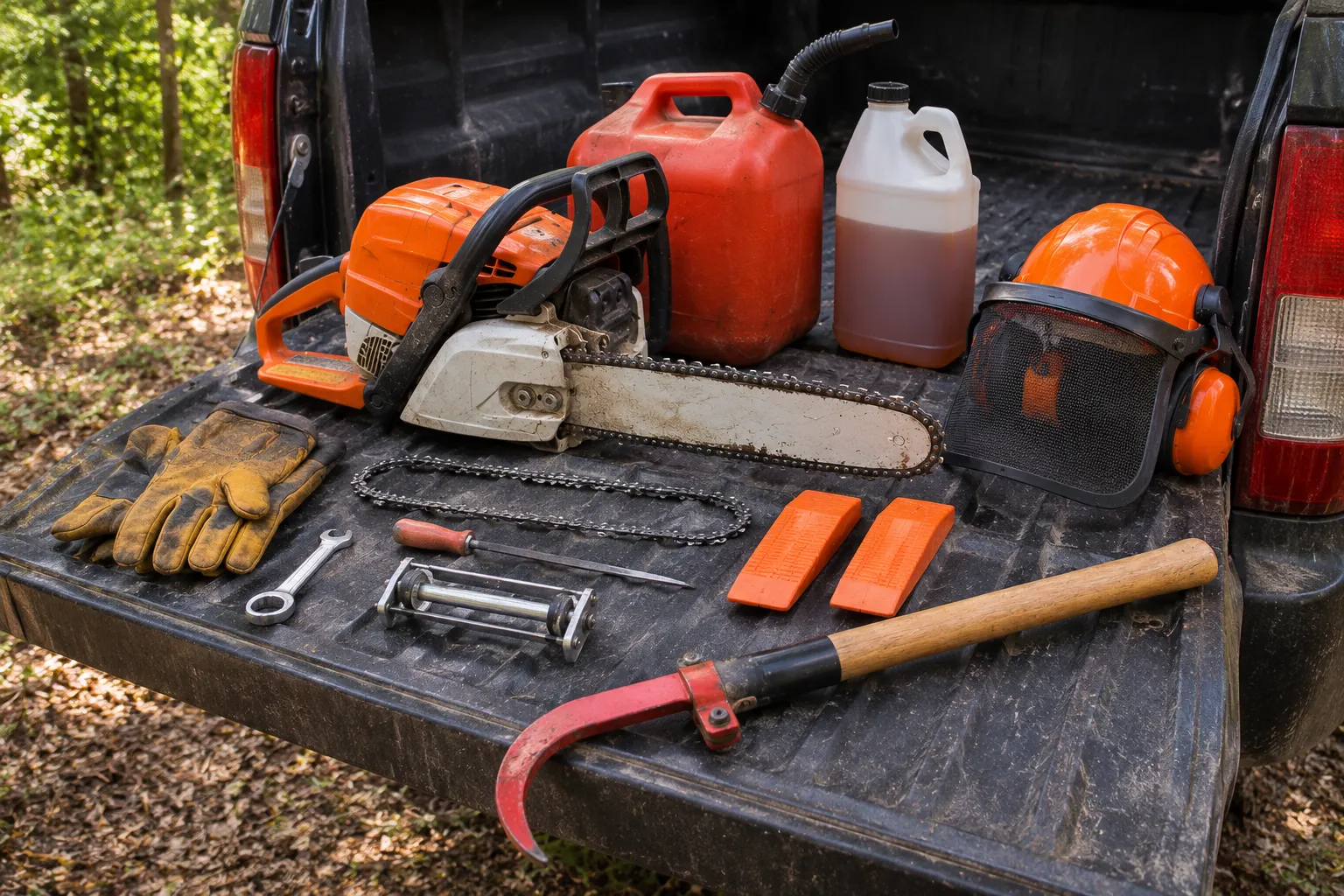
A chainsaw is only one part of a firewood setup. The gear around it decides how safe the job is, how well the saw cuts, and how much your back hurts afterward. Many owners know the saw and skip the rest, including some items they have never heard of.
This guide is the hub for the whole site. It lists about 28 accessories in six groups, with what each one is for, a rough price, and a link to our detailed guide where one exists. It is based on manufacturer pages, retailer listings, safety standards and published guidance from extension services and OSHA. Prices are approximate and were checked in November 2026.
Wear
Protective gear comes first because it is the part that protects you when something goes wrong. Our full walk-through is what to wear when using a chainsaw. Check your saw’s manual for the gear its maker requires.
| Item | Problem it solves | Approx. price | Guide |
|---|---|---|---|
| Helmet system | Falling limbs and head strikes, with visor and ear muffs on one frame | $50 to $150 | Best chainsaw helmet |
| Safety glasses or mesh visor | Chips, sawdust and twigs in the eyes | $10 to $40 | Covered in the helmet guide |
| Hearing protection | Noise that can pass 90 dB | $10 to $50 | Covered in the helmet guide |
| Chainsaw chaps | Chain contact with the thigh and shin, with fibers that clog the chain | $50 to $160 | Best chainsaw chaps |
| Chainsaw gloves | Grip, scrapes, splinters and some cut resistance | $20 to $90 | Best chainsaw gloves |
| Chainsaw boots | Cut-resistant foot protection, ankle support and traction | $120 to $350 | Best chainsaw boots |
Look for ANSI Z89.1 on helmets, ANSI Z87.1 on eye protection and ASTM F1897 on chaps. A helmet and chaps are the two purchases to make before anything else on this page.
Keep it cutting
A dull or badly set chain makes you push, which is when mistakes happen. A few small tools keep the saw cutting well.
| Item | Problem it solves | Approx. price | Guide |
|---|---|---|---|
| Chain sharpener | Dull cutters that make dust, not chips | $50 to $185 | Best chainsaw sharpener |
| Depth gauge tool and flat file | Rakers that are too high after several sharpenings | $5 to $10 | See below |
| Stump vise | Holds the bar steady in a stump or log while you file | $15 to $45 | See below |
| Spare chain | A fresh chain when one hits dirt or a rock | $15 to $40 | Chain for hardwood |
| Scrench and spare bar nuts | Adjusting tension, swapping a chain, and a lost nut in the field | $5 to $20 | No guide |
| Grease gun for the bar nose | Lubricates the sprocket in the bar tip on bars that have a grease hole | $10 to $22 | See below |
Sharpener. A guided file or a bar-mounted tool gives even cutters, and that makes the biggest difference of any item in this group.
Depth gauge tool. Each cutter has a small ramp in front of it, the depth gauge or raker. As the cutters shorten with sharpening, the gauge must be lowered, or the chain will not bite well even when sharp. A depth gauge tool and a flat file take a minute and cost about ten dollars. Check every few sharpenings, and use the setting the chain’s maker gives (commonly .025 inch for many chains).
Stump vise. This is a steel clamp you drive into a stump or log. The bar sits in the jaws so the saw does not wobble while you file. It is a cheap addition to any file guide and it is what makes field sharpening easy.
Spare chain. Carry a second chain, already sharp and the right size. To buy the right one, measure pitch, gauge and drive link count, or use our chain finder and the guides on chain pitch and how to measure a chain. If you change chains, see how to put a chain on a chainsaw.
Scrench and spare bar nuts. Most saws ship with a scrench, and it tends to go missing. A spare, plus a spare set of bar nuts, keeps a lost nut from ending the day. Nuts are specific to the saw model, so buy from the saw maker or a dealer.
Grease gun for the bar nose. Some bars have a sprocket in the tip that needs grease. Not all do, so look for a small hole at the nose and follow the saw’s manual. A single-use gun with a pointed tip costs about ten to twenty dollars.
Fuel and oil
| Item | Problem it solves | Approx. price | Guide |
|---|---|---|---|
| Fuel and oil combo can | Carries mixed fuel and bar oil in one container, with separate spouts | Roughly $35 to $70 for branded twin cans | No guide |
| Two-stroke oil | Proper lubrication at the right mix ratio for a gas saw | $10 to $25 a bottle | Best 2-stroke oil |
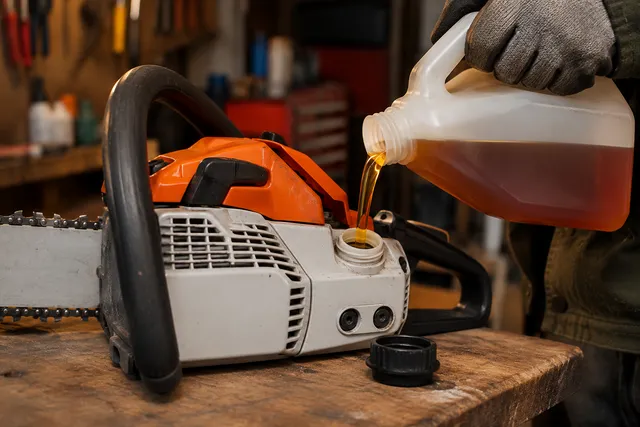
| Bar and chain oil | Keeps the chain from running dry and burning the bar | $15 to $40 a gallon | Best bar and chain oil |
Combo can. A twin-compartment can holds fuel on one side and bar oil on the other, so you cannot mix them up and you only carry one container. Stihl and Husqvarna both sell versions. The fuel side sizes vary, and the price depends on the brand, so check current listings. Use the fuel mix calculator to get the ratio right, and follow the mix your saw’s manual specifies.
Two-stroke oil and bar oil. These are different products. The first goes into the fuel, and the second goes into the bar oil tank. The guides above compare brands. Check that the oil meets what your saw’s maker requires.
Move and hold the wood
This group is the least known and does the most for your back and your saw.
| Item | Problem it solves | Approx. price | Guide |
|---|---|---|---|
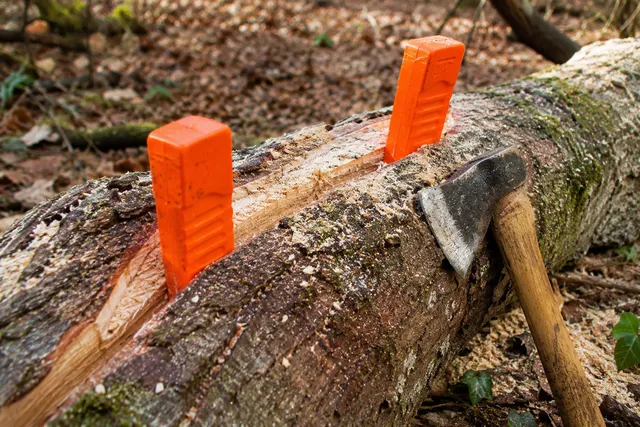
| Felling wedges | Holds a cut open so the saw does not pinch | $10 to $30 for a set | Best felling wedges |
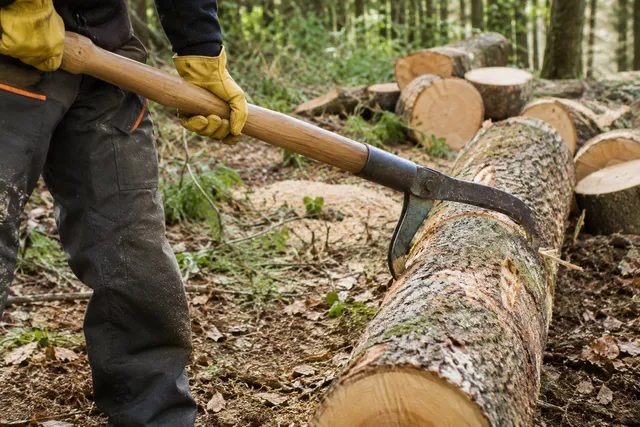
| Cant hook or timberjack | Rolls and lifts logs so you do not have to bend and heave | $40 to $100 | Best cant hook |
| Log tongs | Lifts and drags short logs by hand | $15 to $40 | Best log tongs |
| Hookaroon | A short hooked tool that drags logs and rounds across the ground | $40 to $100 | See below |
| Sawbuck | Holds logs at waist height and keeps the chain out of dirt | $30 to $100 | Best sawbuck |
| Marking stick | A stick cut to stove length so every round is the same | Free | See how to buck a log |
Felling wedges. A plastic wedge in the cut opens it and stops the bar from pinching. They also help direct a tree when felling. Use plastic or wood, not metal, near the chain.
Cant hook or timberjack. A cant hook has a long handle and a swinging hook that turns round logs. A timberjack lifts a log off the ground so you can cut through without hitting dirt. Both let you work from a standing position.
Hookaroon. A hookaroon, also called a pickaroon, is a short handle with a pointed steel hook. You sink the point in a log and drag it, which saves bending and keeps hands clear of the log. Hardwood-handled models run about $45 and steel models cost more.
Sawbuck. It is an X-shaped frame that keeps a log at a good working height. The full method is in how to buck a log.
Marking stick. Cut a stick to the length your stove takes and mark every cut with it. It costs nothing and saves recutting.
Split and stack
| Item | Problem it solves | Approx. price | Guide |
|---|---|---|---|
| Splitting axe or maul | Splits rounds by hand | $50 to $150 | Best splitting axe |
| Log splitter | Splits big or knotty rounds without swinging | Hundreds to several thousand | Best log splitter, best gas log splitter |
| Firewood rack | Keeps stacked wood off the ground so it dries | $30 to $150 | Best firewood rack |
| Moisture meter | Tells you when wood is dry enough to burn, which is about 20 percent or less | $15 to $60 | Best firewood moisture meter |
Burning wet wood wastes heat and builds creosote in the chimney. A pin-type moisture meter, used on a freshly split face, tells you if wood is ready. For the planning side, see the cord of wood calculator and the firewood BTU chart.
Carry and store
| Item | Problem it solves | Approx. price | Guide |
|---|---|---|---|
| Bar cover | Protects the chain, and protects you from it, in transit | $10 to $15 | See below |
| First-aid kit with trauma supplies | Pressure bandages and a tourniquet for severe bleeding | $30 to $40 for a trauma pack | See below |
| Saw case or storage plan | Protects the saw between seasons | Varies | How to store a chainsaw |
Bar cover. A cover slides over the bar and chain. It stops the teeth from catching on a bag or a hand, and it keeps the chain from being damaged in the truck. An adjustable cover costs about ten dollars.
First-aid kit. Gear lowers the odds of an injury, and a kit helps if one happens. OSHA requires first-aid kits at logging sites. At home, keep a kit with pressure bandages and a tourniquet where you can reach it fast, along with a charged phone. Stop the Bleed guidance says to call 911 first and use firm direct pressure, and a tourniquet if a limb wound keeps bleeding. Take a class so you know how to use it.
Storage and upkeep. See how to store a chainsaw, the maintenance checklist and how to clean a chainsaw.
Starter kit for under $150
This list uses low-end prices from the ranges above. It assumes you already own a saw and sturdy leather boots. It will not include everything, and it favors safety.
- Chainsaw chaps, about $55. A label showing ASTM F1897 is the key.
- Helmet with visor and ear muffs, about $50. The cheapest way to cover head, eyes and ears.
- Leather work gloves, about $12. Upgrade to saw-protection gloves later.
- Depth gauge tool and flat file, about $10.
- Two plastic felling wedges, about $12.
- A marking stick, free.
That totals about $139. When you can, add a first-aid kit with a tourniquet, a bar cover, a spare chain and a stump vise, in roughly that order, and chainsaw-rated boots when the budget allows. Do not buy used chaps or a used helmet if you do not know their history.
Bottom line
Buy protective gear first, then the small tools that keep the chain cutting, then the ones that save your back. The cheap items are often the most useful: wedges, a depth gauge tool, a bar cover and a marking stick together cost less than a new chain. Follow your saw’s manual, and read chainsaw kickback before you cut.
Common questions
What chainsaw accessories do I need first?
Safety gear comes first: chaps, a helmet with face screen and hearing protection, gloves and sturdy boots. After that, the most useful items are a way to sharpen the chain, a spare chain, a scrench for adjustments and a pair of felling wedges.
What is a chainsaw scrench?
A scrench is a combined screwdriver and wrench, usually a socket wrench with a screwdriver blade on the other end. It fits the bar nuts and the spark plug on many saws and usually ships in the box. Keep a spare in the truck and a spare set of bar nuts.
What is a depth gauge tool for?
It sets the height of the small ramps in front of each cutter, called depth gauges or rakers. They control how deep each cutter bites. A flat file and a gauge tool lower them as the cutters wear, which restores cutting speed after sharpening.
Do I need a bar cover?
A cover protects the chain from damage and protects you from the chain when you carry or store the saw. It is cheap and takes a second to fit, so it is worth having if the saw travels in a truck or a trunk.
Should I mix my own fuel or buy premix?
Both work if you use the ratio the saw maker specifies. Mixing your own in a combo can costs less per gallon. Premixed fuel costs more but keeps longer. Our fuel mix calculator helps with the math.