A chainsaw engine has no oil sump. The oil you mix into the gasoline is the only thing lubricating the piston, cylinder and bearings, and a bottle that treats a gallon costs a few dollars. It is the cheapest insurance a saw gets.
The harder question is which oil. Labels mention JASO FD, ISO-L-EGD, synthetic, semi-synthetic and low smoke, and every saw maker recommends its own brand.
This guide compares four oils and one premixed fuel that are widely sold in the US. It is based on manufacturer specifications and retailer listings, not on hands-on testing. Prices are approximate and were checked in November 2026.
Quick comparison
| Product | Type | Listed rating | Maker’s mix ratio | Approx. price |
|---|---|---|---|---|
| Echo Red Armor | Semi-synthetic oil | JASO FD, ISO-L-EGD | 50:1 | $3.50 to $5 per 6.4 oz |
| Husqvarna XP+ | Synthetic blend oil | JASO FD | 50:1 | From about $3.50 per 2.6 oz |
| Stihl HP Ultra | Fully synthetic oil | JASO FB, ISO-L-EGB | 50:1 | About $5.50 to $6 per 6.4 oz |
| Amsoil Saber Professional | Fully synthetic oil | For JASO FD, ISO-L-EGD and API TC uses | 100:1 or 80:1 promoted | Check Amsoil |
| TruFuel 50:1 | Premixed canned fuel | Oil exceeds JASO FD and ISO-L-EGD | Ready to use | $9 to $18 per 32 oz |
A 2.6 oz bottle treats 1 gallon at 50:1, and a 6.4 oz bottle treats 2.5 gallons.
1. Echo Red Armor: best overall
Red Armor has the clearest paperwork of the oils here. Echo lists it as a semi-synthetic oil for a 50:1 mix, and its spec sheet states that it is JASO FD registered and ISO-L-EGD compliant. Those are the top current ratings for air-cooled 2-stroke oil.
It is sold by Echo dealers, farm stores and big-box retailers in 2.6 oz, 5.2 oz, 6.4 oz and 12.8 oz bottles and in 1-gallon jugs. Dealers listed the 6.4 oz bottle at about $3.50 to $5 and the 2.6 oz bottle at about $4.50. Prices on large marketplaces were sometimes much higher for a single bottle, so buy locally or by the multi-pack.
Good
- Both JASO FD and ISO-L-EGD stated on the maker’s spec sheet
- Low price per gallon of mix
- Many bottle sizes, widely stocked
Not so good
- Semi-synthetic, not fully synthetic
- Single-bottle prices vary a lot between sellers
- Does not count toward other brands’ warranty offers
Buy it if you want a certified, reasonably priced oil for any modern 50:1 saw, whatever the brand.
2. Husqvarna XP+: best for Husqvarna saws
Husqvarna describes XP+ as a synthetic blend made with semi-synthetic base oils. It is JASO FD certified and carries Husqvarna’s own Verified Engine Formula approval. Husqvarna also states that it contains fuel stabilizer, which helps when a can of mix sits for a while. Husqvarna’s product page does not list an ISO rating.
Sizes run from 2.6 oz through 5.2 oz, 6.4 oz and 12.8 oz to 1-gallon, 5-gallon and 55-gallon containers. Husqvarna lists it from $3.49, and single 2.6 oz bottles at general retailers were priced well above that.
Good
- JASO FD certified
- Fuel stabilizer included
- Sold in everything from single-gallon bottles to drums
Not so good
- No ISO rating on the maker’s page
- Synthetic blend, not fully synthetic
- Marked up at some general retailers
Buy it if you run a Husqvarna and want the oil its maker approves, with stabilizer already in it.
3. Stihl HP Ultra: best for Stihl saws
HP Ultra is Stihl’s premium oil. Stihl describes it as fully synthetic and suited to high-performance chainsaws, with an ash-free additive that burns with very low residue. The recommended ratio is 50:1.
One detail is worth knowing: Stihl’s own product pages list the performance class as JASO FB and ISO-L-EGB, not FD and EGD. If a rating on the label is your priority, Red Armor and XP+ have the higher listed class.
The practical reason to buy it is the warranty. Stihl states that buying a six-pack of HP Ultra, or at least a gallon of its MotoMix premixed fuel, with a qualifying gasoline-powered product doubles the limited warranty for personal household use. Restrictions apply, so ask the dealer at the time of purchase.
Retailers listed the 6.4 oz bottle at about $5.50 to $6 and a 12.8 oz bottle at about $12. It is also sold in 2.6 oz bottles.
Good
- Fully synthetic
- Can double the warranty on a new Stihl when bought with the saw
- Stocked by every Stihl dealer
Not so good
- Listed as JASO FB and ISO-L-EGB, a lower class than its rivals
- Costs more per bottle than Red Armor
- Stihl’s own online store sells it by the case; single bottles come from dealers and retailers
Buy it if you are buying a new Stihl saw and want the longer warranty, or simply prefer to stay with the maker’s oil.
4. Amsoil Saber Professional: best universal synthetic
Saber Professional is a fully synthetic oil from an independent brand. Amsoil lists it for handheld 2-stroke equipment and for applications that call for JASO FD, ISO-L-EGD or API TC, and names Stihl, Husqvarna and Echo among the brands it is meant for.
Amsoil promotes lean mixes of 80:1 and 100:1 with this oil, and its data sheet also gives the conventional 50:1 figure of 2.6 oz per gallon. A lean mix is the oil maker’s recommendation, not the saw maker’s. Running a different ratio from the one in your manual could affect a warranty claim, so mixing at the manual’s ratio is the safe choice.
It is sold through Amsoil’s website and dealers. We could not confirm current per-size prices, so check Amsoil directly.
Good
- Fully synthetic
- One oil for a mixed fleet of brands
- Mixing data published for 50:1, 80:1 and 100:1
Not so good
- Mostly sold online or through dealers, not on store shelves
- Promoted lean ratios differ from saw makers’ instructions
- Listed as suitable for JASO FD uses, which is not the same wording as a registration
Buy it if you own saws and trimmers from several brands and want a single fully synthetic oil for all of them.
5. TruFuel 50:1: best premixed fuel
TruFuel is gasoline and oil already blended at 50:1 and sealed in a can. Retailers describe it as ethanol-free, with a base fuel of 92 octane or higher and a synthetic oil that exceeds JASO FD, ISO-L-EGD and API TC requirements. Ace Hardware lists a shelf life of five years unopened and two years after opening.
It comes in 32 oz and 110 oz cans. Tractor Supply listed the 32 oz can at about $9 to $10 and the 110 oz can at about $23; other retailers were higher. That works out to more than $25 a gallon, so it is a convenience product, not a way to save money.
Stihl’s MotoMix is a similar product, described by retailers as non-ethanol fuel blended with HP Ultra oil.
Good
- No measuring and no mixing errors
- Ethanol-free, with a long shelf life
- Sold at most hardware and farm stores
Not so good
- Several times the cost per gallon of mixing your own
- Only for saws that call for 50:1
- Leaves empty cans to dispose of
Buy it if you use a saw a few times a year and want fuel that will still be good next season.
Mix ratio chart: 50:1 and 40:1
Fifty to one is standard for modern saws, but your manual has the final word.
| Gasoline | Oil at 50:1 | Oil at 40:1 |
|---|---|---|
| 1 US gallon | 2.6 fl oz | 3.2 fl oz |
| 2 US gallons | 5.1 fl oz | 6.4 fl oz |
| 2.5 US gallons | 6.4 fl oz | 8.0 fl oz |
| 5 US gallons | 12.8 fl oz | 16.0 fl oz |
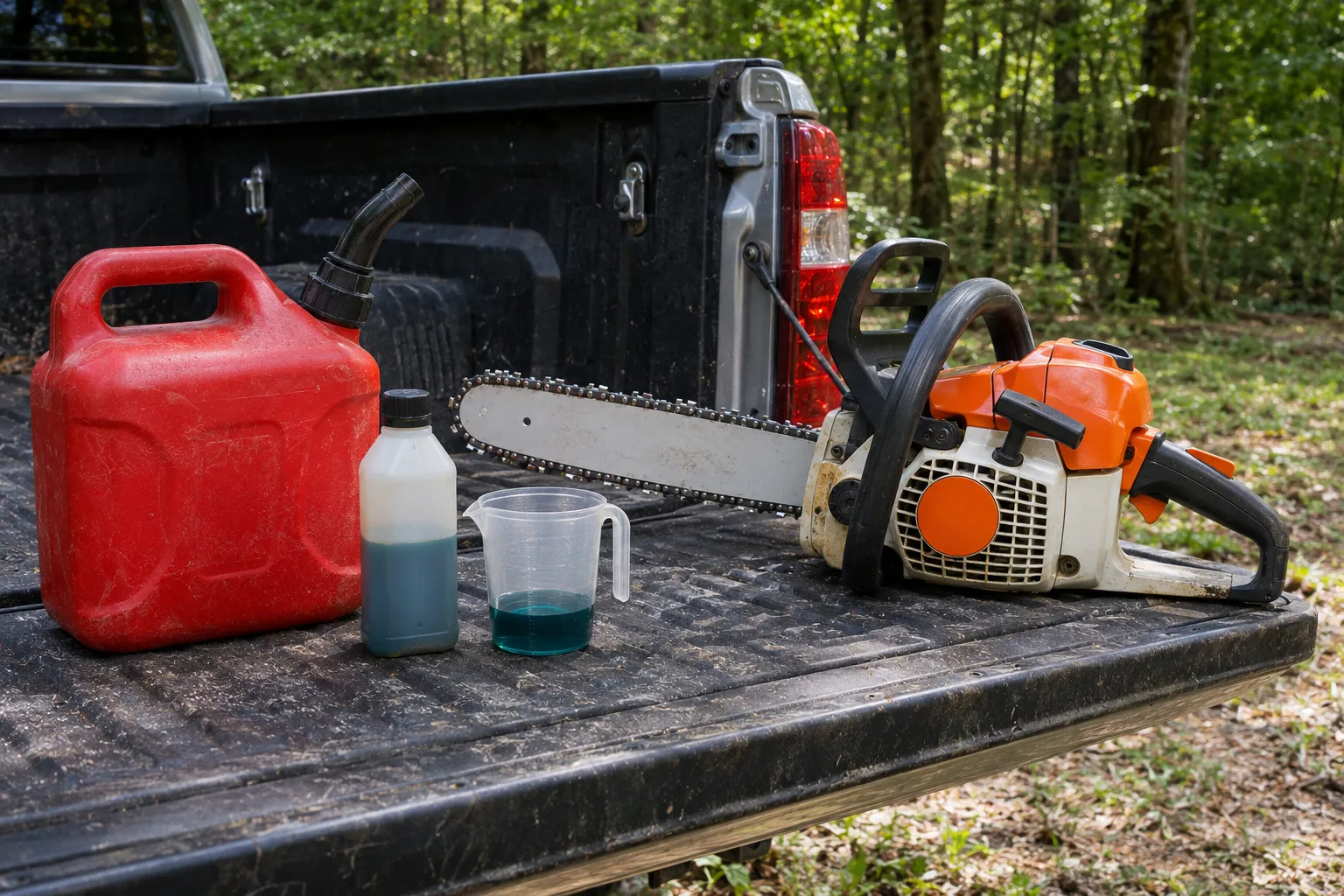
Pour the oil into an approved fuel can, add the gasoline, close the can and shake it before each fill.
How to choose a 2-cycle oil for a chainsaw
Read the rating before the brand
JASO FD and ISO-L-EGD are the highest current classes for air-cooled 2-stroke oil. Both include limits on smoke and on deposits. FB and EGB are earlier, lower classes. API TC is an older standard that many oils also list.
Follow the manual on ratio
More oil is not safer. A mix that is too rich can foul the plug and build carbon; a mix that is too lean risks scoring the piston. Use the ratio in the manual, and measure it.
Buy bottles that match your gas can
Single-dose bottles remove the measuring. A 2.6 oz bottle suits a 1-gallon can, and a 6.4 oz bottle suits a 2.5-gallon can.
Use fresh fuel
Stihl recommends gasoline of at least 89 octane for its mix. Buy fuel in small amounts, avoid blends above 10 percent ethanol, and do not leave mix in the saw over the off season.
A note on safety
Mix fuel outdoors, away from sparks and flames, in a container approved for gasoline, and let a hot saw cool before refueling. For the next steps, see our guide on how to start a chainsaw.
If mixing fuel is the part you would like to skip altogether, our electric vs gas chainsaw comparison covers the battery alternatives.
Bottom line
For most owners, Echo Red Armor is the best 2 stroke oil for a chainsaw: it carries both top ratings on the maker’s spec sheet and costs little per gallon. Stay with Husqvarna XP+ or Stihl HP Ultra if you want the oil your saw’s maker approves, and note that HP Ultra can double the warranty on a new Stihl. Amsoil Saber Professional suits a mixed fleet, and TruFuel 50:1 is the easy answer for a saw that only comes out a few times a year.
Common questions
What is the mix ratio for a chainsaw?
Most modern chainsaws from Stihl, Husqvarna and Echo call for 50:1, which is 2.6 fluid ounces of oil per US gallon of gasoline. Some older saws and other brands specify 40:1 or a richer mix. Always follow the ratio in your saw's manual.
Can I use any 2-cycle oil in my chainsaw?
Use an oil made for air-cooled 2-stroke engines. Oils rated JASO FD or ISO-L-EGD meet the highest current standards for these engines. Do not use outboard marine oil rated TC-W3, which is formulated for water-cooled engines that run cooler than a chainsaw.
Is synthetic 2-stroke oil better than conventional?
Synthetic and semi-synthetic oils generally burn cleaner and leave fewer deposits than plain mineral oil, which is why saw makers sell them as their premium grades. The certification on the label is a more reliable guide than the word synthetic on its own.
How long does mixed 2-stroke fuel last?
Fuel mixed with pump gasoline goes stale in a matter of weeks to a few months, sooner if the gasoline contains ethanol. Mix only what you expect to use soon and store it in a sealed, approved container. Canned premixed fuel lasts much longer; retailers list TruFuel at about five years unopened and two years after opening.
Is premixed canned fuel worth the price?
It costs several times more per gallon than mixing your own, so it rarely makes sense for heavy use. It is worth considering if you run a saw only a few times a year, because it is ethanol-free, stores for years and removes any chance of a mixing mistake.