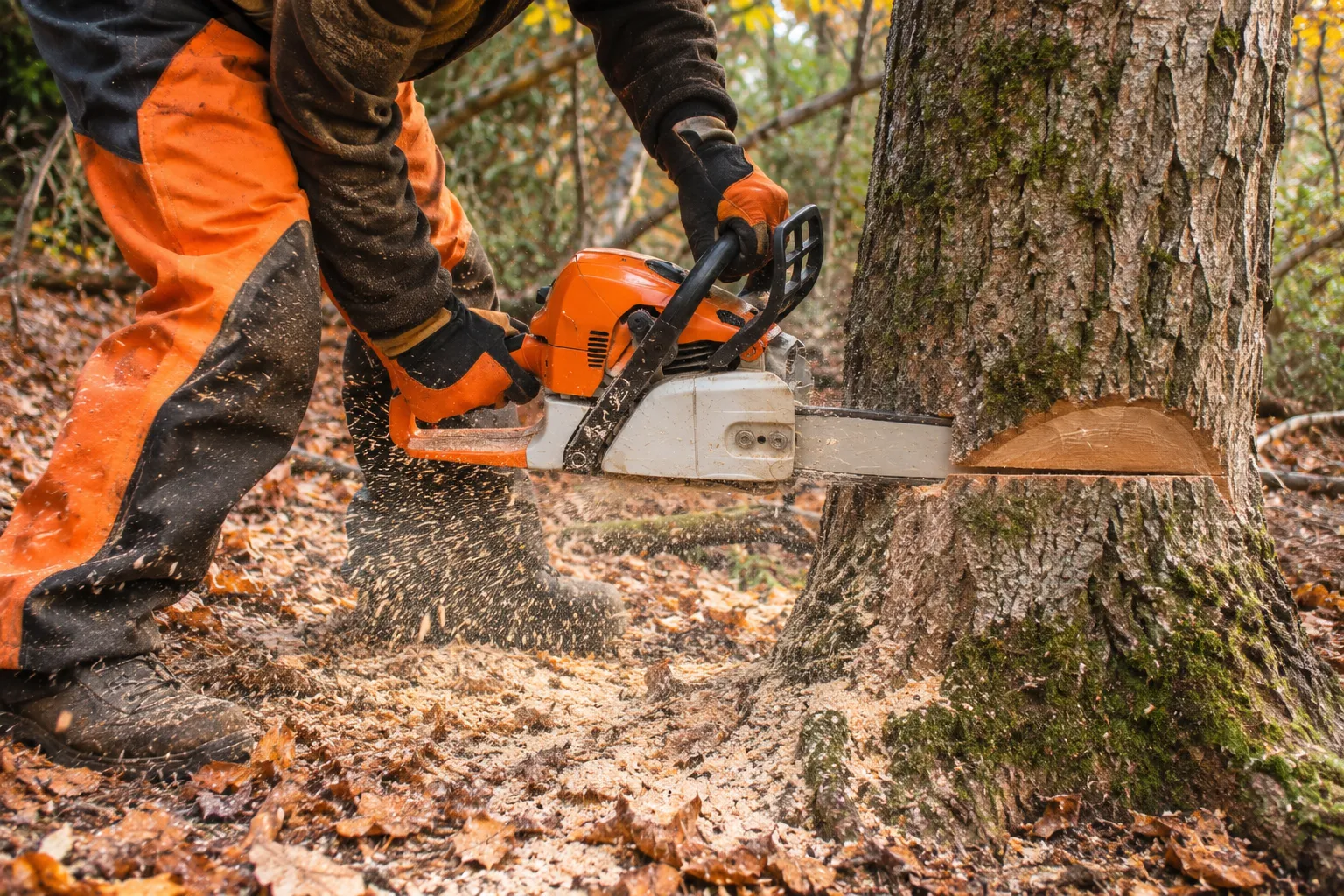
Bucking a log that is already on the ground is one job. Putting a standing tree on the ground is another. You need a bar long enough to make the notch and the back cut in a single pass, an engine that keeps the chain moving through the full width of the trunk, and a saw you can still control when you limb the tree afterward.
So the best chainsaw for cutting trees depends mostly on the trees. This guide sorts five saws by trunk diameter, with gas and battery options for small and medium trees on your own land. It is based on manufacturer specifications, retailer listings and published reviews, not on hands-on testing. Prices are approximate and were checked in November 2026.
The rule of thumb: bar length and trunk diameter
Measure the trunk where you plan to cut, usually a foot or so above the ground. Pick a bar about 2 inches longer than that diameter. The extra length keeps the bar tip outside the wood, which lowers the risk of kickback and lets you see where the cut ends.
Do not go longer than you need. A long bar is heavier, harder to steer while limbing, and slower on a small engine.
Quick comparison
| Chainsaw | Power | Bar | Weight | Approx. price | Trunk diameter |
|---|---|---|---|---|---|
| Echo CS-4010 | 41.6 cc gas | 16” or 18” | About 9.4 lb dry | $320 to $350 | Up to about 12” |
| EGO Power+ CS1611 | 56V battery | 16” | About 9 lb without battery | $280 to $350 (kit) | Up to about 12” |
| Husqvarna 450S Rancher | 50.2 cc gas | 20” | 11.0 lb | About $500 | 12” to 16” |
| Echo eFORCE DCS-5000 | 56V battery | 18” | 14.6 lb with battery | $300 to $350 (kit) | 12” to 16” |
| Husqvarna 460 Rancher | 60.3 cc gas | 24” | 13.2 lb | $500 to $650 | 16” to 20” |
Gas saw weights are for the powerhead without bar and chain, as the makers list them.
Small trees, up to about 12 inches
Most backyard removals fall in this group: volunteer maples, dead ornamentals, pines crowding a fence line. A 16-inch bar is enough, and a light saw makes the limbing easier.
1. Echo CS-4010: best gas saw for small trees
The CS-4010 is Echo’s current 41.6 cc homeowner saw, sold with a 16 or 18 inch bar. Echo’s list price is $329.99. Its dry weight is listed at 9.3 to 9.5 pounds depending on the source, which is light for a saw of this size. Echo covers it for 5 years of consumer use.
Choose the 16-inch bar unless you expect trunks close to a foot and a half. The shorter bar is easier to handle in the branches.
Good
- Light enough to limb with for a long session
- Enough engine for a 16-inch bar in hardwood
- 5-year consumer warranty
Not so good
- Works hard with the 18-inch bar buried
- Two-stroke fuel to mix and store
- Still being sold alongside the older CS-400, so check the model
Buy it if you take down a few small trees a year and want a gas saw that is easy to carry.
2. EGO Power+ CS1611: best battery saw for small trees
The CS1611 is a 16-inch, 56V saw sold as a kit with a 2.5Ah battery and charger. EGO rates it for up to 130 cuts on a 4x4 with that battery and compares its power to a 40 cc gas saw. Both are the manufacturer’s claims. Retail listings describe tool-free chain tensioning, a chain brake and a 5-year warranty, and put the bare saw at about 9 pounds.
Kit prices run from about $280 to $350. A single small tree, felled, limbed and cut up, is a realistic job for one charge. Several trees are not, unless you own a larger EGO battery.
Good
- Starts with a trigger, with no fuel to mix
- Tool-free chain tensioning
- Battery fits other EGO 56V tools
Not so good
- The small 2.5Ah kit battery limits a day’s work
- Runtime figures are measured in small lumber, not hardwood trunks
- Extra batteries are expensive
Buy it if you remove an occasional small tree near the house and would rather not keep a gas saw.
Medium trees, about 12 to 16 inches
At this size the tree is heavy enough to do real damage, and the saw has to stay in the cut longer. An 18 or 20 inch bar and about 50 cc, or a full-size battery saw, is the sensible range.
3. Husqvarna 450S Rancher: best overall for felling
Husqvarna lists the 450S Rancher at 50.2 cc, 3.2 horsepower and 11 pounds without cutting equipment. It comes with a 20-inch bar and a .325” pitch chain, and the list price is $499.99.
The features Husqvarna lists suit felling work: Smart Start for easier starting, Air Injection to keep debris out of the air filter, LowVib anti-vibration mounts and an inertia-activated chain brake. Eleven pounds is light for a 50 cc saw, which you will notice while limbing.
Good
- A 20-inch bar covers most trees a homeowner should fell
- Light for its engine size
- Sold online, at retailers and through dealers
Not so good
- Slows down with the full bar in dense hardwood
- Easy to confuse with the older 450 Rancher
- More saw than small yard trees need
Buy it if you have a wooded lot and want one saw for felling, limbing and bucking.
4. Echo eFORCE DCS-5000: best battery saw for medium trees
The DCS-5000 is an 18-inch rear-handle saw on Echo’s 56V platform. The kit with a 5.0Ah battery and charger is listed at about $300 to $350. Echo claims up to 200 cuts in 4x4 lumber per charge. One arborist supplier lists it at 14.6 pounds with the battery, and gives the chain as 3/8” low profile, .050” gauge.
It has metal bumper spikes, which help you pivot the saw through a back cut, and a side-access chain tensioner.
Good
- 18-inch bar on a battery saw
- Larger 5.0Ah battery in the kit
- Much quieter than a gas saw near neighbors
Not so good
- Heavier ready to cut than the 450S Rancher powerhead
- One battery will not cover a day of felling
- Chain tensioning needs a tool
Buy it if you fell a medium tree now and then and want to skip fuel and pull starts.
For more cordless choices, see our best electric chainsaw guide and the electric vs gas chainsaw comparison.
Larger trees, about 16 to 20 inches
This is the upper limit of what this guide covers. A tree this size is very heavy, and the margin for error is small.
5. Husqvarna 460 Rancher: best for larger trunks
The 460 Rancher is a 60.3 cc saw with 3.62 horsepower, sold with a 24-inch bar and a 3/8” pitch chain. Husqvarna lists it at 13.2 pounds without cutting equipment. The list price is $649.99, and Husqvarna’s site showed a promotional price of $499.99.
Husqvarna lists felling marks on the body to help you aim the fall, a decompression valve for easier starting and an adjustable oil pump for the long bar.
Good
- 24-inch bar clears trunks up to about 20 inches in one pass
- Felling marks and decompression valve
- Promotional price matched a 50 cc saw when checked
Not so good
- Heavy and long for limbing
- Too much saw for a first-time user
- Uses more fuel than the smaller saws
Buy it if you have experience with a smaller saw and regularly deal with trunks over 16 inches.
Felling safety: read this before you buy
Felling is the most dangerous job you can do with a chainsaw. The saw is only part of the risk. Most of it comes from the tree.
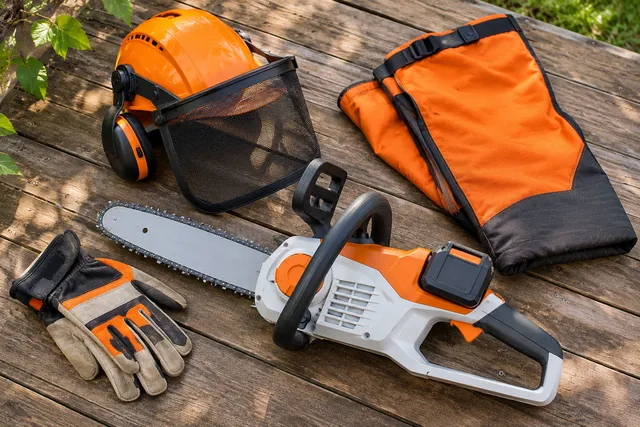
- Wear the gear every time. Chainsaw chaps, a helmet with a face screen and ear protection, gloves and sturdy boots.
- Plan and clear an escape route before the first cut. OSHA’s logging guidance describes a retreat path at about 45 degrees back and away from the direction of fall, never straight behind the trunk.
- Check the tree first. Look for lean, dead limbs overhead, rot at the base and anything the tree could hang up on.
- Keep people and pets well back, at least twice the height of the tree.
- Never cut alone, and never cut above shoulder height or from a ladder.
Hire a professional for large trees, leaning trees, dead or rotten trees, and anything that could reach a building, a road or a power line. Stay away from any tree touching or near a line and call the utility.
If you are new to saws, start with our guides to how to start a chainsaw and the best chainsaws for beginners, and practice on logs before you face a standing tree.
How to choose a chainsaw for cutting trees
- Start from the largest trunk you will really cut, then add 2 inches for the bar.
- Match the engine to the bar. About 40 cc for 16 inches, 50 cc for 18 to 20 inches and 60 cc for 24 inches.
- Think about the limbing. You will spend more time removing branches than felling, so weight matters.
- Keep the chain sharp. A dull chain wanders in the cut, which is the last thing you want in a back cut. See our chainsaw sharpener guide.
- Plan for the wood. If the trees are headed for the stove, see the best chainsaw for firewood.
Stihl buyers will find matching sizes in our best Stihl chainsaw guide.
Bottom line
For most property owners, the Husqvarna 450S Rancher is the best chainsaw for cutting trees: a 20-inch bar, 50 cc and low weight cover trunks up to about 16 inches. For small trees, the Echo CS-4010 is lighter and cheaper, and the EGO CS1611 does the job without gas. The Echo DCS-5000 is the battery choice for medium trees, and the Husqvarna 460 Rancher handles trunks up to about 20 inches. Beyond that, or near anything you cannot afford to hit, call a tree service.
Common questions
What size chainsaw do I need to cut down a tree?
Measure the trunk at the height where you will cut and choose a bar about 2 inches longer. A 16 inch bar suits trunks up to about 12 inches, an 18 or 20 inch bar suits 12 to 16 inches, and a 24 inch bar covers trunks up to about 20 inches.
Can a battery chainsaw cut down a tree?
Yes, within its bar length. A 16 or 18 inch battery saw can fell and limb small to medium trees, and it is quieter and simpler to start than gas. For several trees in a day or trunks over about 16 inches, a gas saw is the more practical tool.
Can I fell a tree that is thicker than my bar?
Experienced cutters do it by cutting from both sides, but it makes the hinge harder to judge and puts the bar tip inside the cut, where kickback starts. If the trunk is wider than your bar, use a bigger saw or hire a professional.
How many cc do I need for felling trees?
Around 40 cc is enough for trunks up to about a foot. About 50 cc suits trees of 12 to 16 inches, and about 60 cc with a 24 inch bar suits trunks up to roughly 20 inches.
When should I hire a professional instead?
Hire a professional for large trees, for trees that lean or have dead tops or rot, and for anything within falling distance of a building, road or power line. Call the utility for any tree near a line.