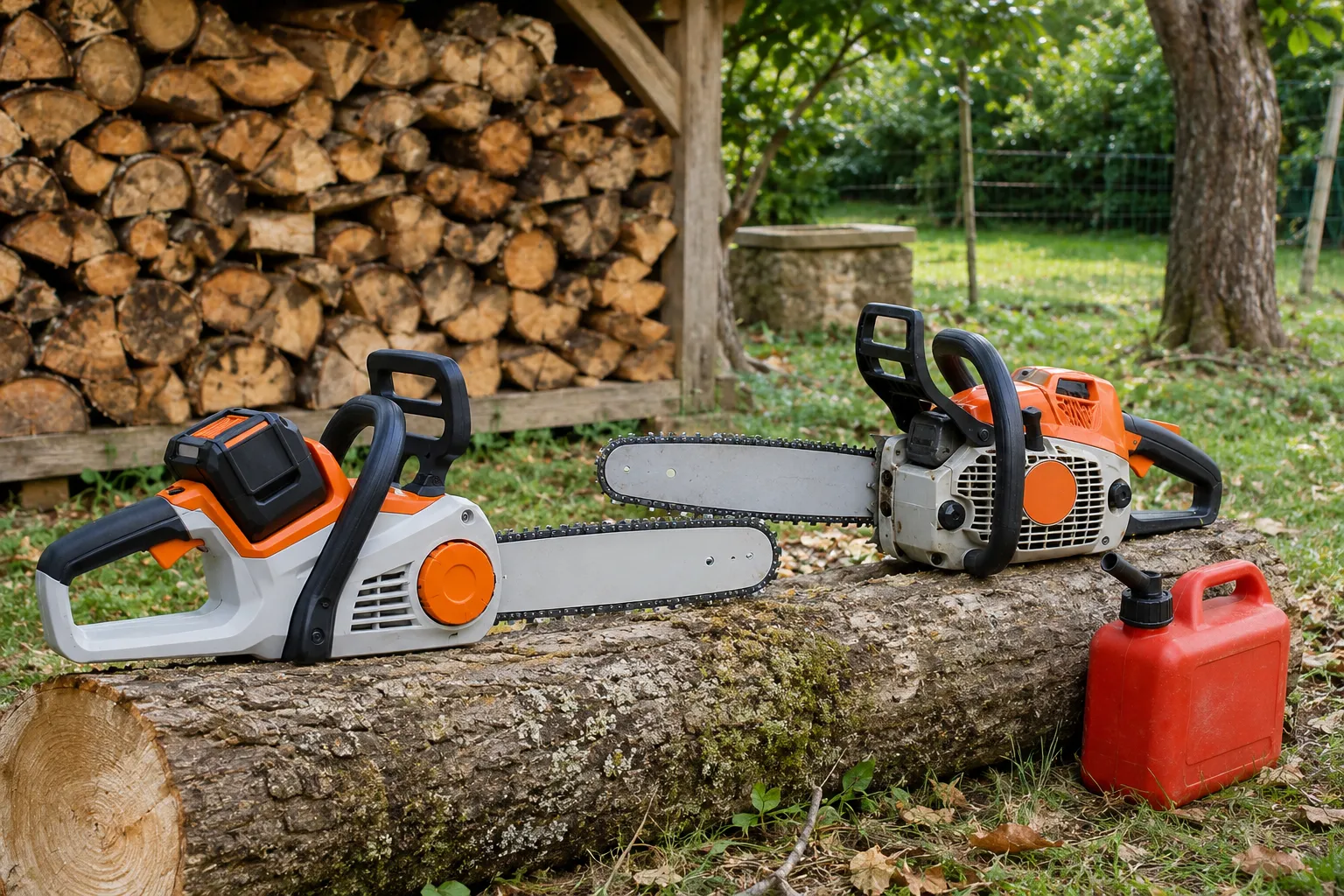
The short answer on electric vs gas chainsaw: a gas saw is still the tool for long days, long bars and big wood, because it has the most power and refuels in a minute. A battery saw now covers most homeowner work, including storm cleanup and a modest firewood pile, with less noise and far less upkeep. A corded saw costs the least and never runs flat, but only works within reach of an outlet.
This comparison is based on manufacturer specifications, retailer listings and published reviews. Nothing here comes from hands-on testing. Prices are approximate and were checked in November 2026.
At a glance
| Gas | Battery | Corded | |
|---|---|---|---|
| Typical homeowner size | 40 to 60 cc | 18V to 56V class | 14.5 to 15 amp |
| Common bar lengths | 16” to 24” | 16” to 20” | 16” to 18” |
| Run time | Until the tank is empty; refuel in about a minute | Limited by the battery; recharge or swap | Unlimited at an outlet |
| Where it works | Anywhere | Anywhere | Within extension cord reach |
| Noise | Loudest | Much quieter | Quieter than gas |
| Starting | Pull cord and choke | Trigger | Trigger |
| Engine upkeep | Fuel mix, air filter, spark plug, carburetor | None | None |
| Approx. price | $320 to $650 for homeowner and farm saws | $250 to $650 for a kit | $100 to $440 |
Power and bar length
Gas saws cover the widest range. Homeowner models start under 40 cc with a 16” bar, farm saws of 50 to 60 cc take 20” or 24” bars, and professional saws go past 90 cc.
Battery saws have closed much of the gap at the homeowner end. Milwaukee says its 16” M18 Fuel saw has the power of a gas engine of up to 40 cc, and EGO compares its 20” CS2005 to a 55 cc gas saw. Those are manufacturer claims measured under their own conditions, not independent figures. Battery bars for homeowners top out at about 20”.
Corded saws use 14.5 or 15 amp motors with 16” or 18” bars. GearLab, which tests saws side by side, found the corded Makita UC4051A cut on par with the best battery models in its test.
Run time versus refueling
This is the main practical difference between battery and gas.
A gas saw runs until the tank is empty, and filling it takes about a minute. With a fuel can beside you, you can cut all day.
A battery saw stops when the pack is empty. Husqvarna quotes about 45 to 55 minutes of standard use for the Power Axe 350i with its included battery, and EGO rates the CS1804 for up to 300 cuts on a 4x4 with a 5.0Ah pack. Expect less in thick hardwood. For longer sessions you need a second battery, which adds to the cost.
A corded saw has no run time limit at all. The limit is distance: you are tied to an outlet and a heavy-gauge extension cord.
Weight
Battery saws are not lighter than gas saws, which surprises many buyers. Husqvarna lists its 50.2 cc 450S Rancher at 11.0 lb without bar, chain and fuel. Outdoor Life weighed the 18” Power Axe 350i at 13 lb 15 oz with its battery, and EGO’s 20” CS2005 is about 19.4 lb with battery.
Once a gas saw has its bar, chain, fuel and oil on board, an 18” battery saw and a 50 cc gas saw end up in the same range. Corded saws are the lightest of the three: Makita lists the UC4051A at a net weight of 12.3 lb, with no battery or fuel to add.
Noise
Electric saws are much quieter. Husqvarna’s own spec sheets list 106 dB(A) at the operator’s ear for the gas 450S Rancher and 91 dB(A) for the battery Power Axe 350i. An electric motor also makes no noise between cuts, while a gas engine idles.
Quieter does not mean quiet. Both figures are high enough that hearing protection is still called for, whichever type you buy.
Starting
An electric saw starts when you release the lockout and pull the trigger. A gas saw needs the choke set, one or more pulls on the starter cord, and a moment to warm up. Modern gas saws have reduced-effort starters, such as Husqvarna’s Smart Start and Echo’s i-30, but there is still a routine to learn. Our guide on how to start a chainsaw walks through it.
Starting matters most for occasional users. A gas saw that sat all year with old fuel in the tank is the one that refuses to start after a storm.
Maintenance
All three types share the cutting side: fill the bar and chain oil, keep the chain tensioned, and sharpen it. A good chainsaw sharpener is worth owning for any of them.
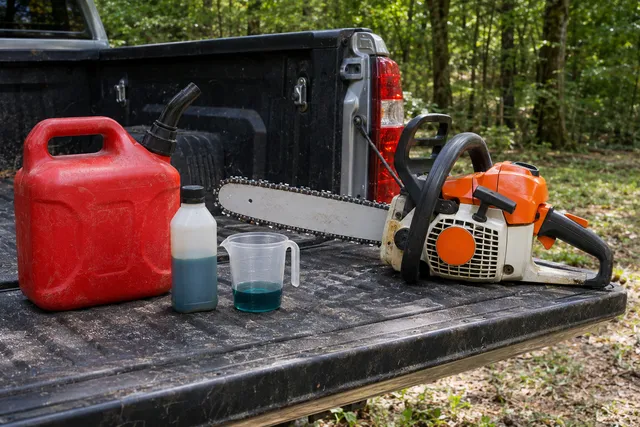
A gas saw adds engine care. Two-stroke saws from makers such as Husqvarna and Echo run on gasoline mixed with 2-stroke oil at 50:1. The air filter and spark plug need cleaning or replacing, and stale fuel can clog the carburetor. Husqvarna states that E15 and E85 fuel are not approved for its products and that damage from old or stale fuel is not covered by warranty. See our guide to the best 2-stroke oil for chainsaws.
An electric saw has none of that. Battery owners should store packs as the manual directs, since a battery is the costly part to replace.
Upfront and running cost
Corded is the cheapest way in: about $100 to $150 for the Oregon CS1500, and $280 to $440 for the Makita UC4051A. Add a heavy-gauge extension cord if you do not own one.
Gas sits in the middle for what you get. The 40.2 cc Echo CS-400 runs about $320 to $360, the 59.8 cc Echo CS-590 Timber Wolf about $430 to $480, and the Husqvarna 450S Rancher about $500.
Battery kits run from about $250 for the EGO CS1804 on sale to $450 to $650 for the EGO CS2005. The battery and charger make up a large part of that price, so a bare tool is much cheaper if you already own the brand’s batteries.
Running costs go the other way. A gas saw needs fuel, 2-stroke oil and tune-up parts every season. An electric saw needs only electricity, bar oil and chains. A battery will eventually need replacing, and makers warrant packs for a shorter period than tools; EGO, for example, covers the tool for 5 years and the battery for 3.
Emissions and local restrictions
A gas saw produces exhaust where you stand. A battery or corded saw produces none at the point of use.
Regulation is mostly a California matter. The California Air Resources Board amended its small off-road engine rules in 2021 to require most new small gas engines sold in the state to be zero emission. CARB’s January 2025 FAQ says the rules apply to manufacturers and sellers of new engines of 25 horsepower or less, that it would fully implement them from the 2026 model year, and that chainsaws under 45 cc are among the covered equipment. The same FAQ says owners are not required to stop using the gas tools they already have.
The rules have been contested at the federal level. DieselNet reported that in September 2026 a federal judge temporarily blocked an attempt to send the EPA authorization behind them to Congress for review. The situation may change, so California buyers should check CARB’s website or a local dealer for what can currently be sold.
Elsewhere, some cities and homeowner associations set their own limits on gas yard equipment or on noisy work hours. These vary widely; check your local rules.
Which type suits which job
| Job | Best fit | Why |
|---|---|---|
| Pruning and limbing | Battery, or corded near the house | Light work, short cuts, instant starts |
| Storm cleanup | Battery or gas | Battery if it is charged and the job is small; gas for a large job or a power outage that lasts days |
| A few cords of firewood | Gas, 45 to 60 cc; battery with a spare pack for a cord or two | Long cutting sessions favor fast refueling |
| Felling larger trees | Gas | Longer bars and sustained power |
| Milling lumber | Gas, large professional saws | Long, continuous full-power cuts |
For firewood in particular, see our guide to the best chainsaw for firewood. First-time buyers can start with the best chainsaws for beginners.
Gas chainsaws
Good
- Widest range of power and bar lengths
- Refuels in about a minute, anywhere
- More engine for the money in the 50 to 60 cc class
Not so good
- Loudest type, with exhaust at the operator
- Fuel mixing, filters, plugs and carburetor care
- Harder to start after long storage
Echo CS-400: a 40.2 cc saw with an 18” bar for a cord or two a year, at about $320 to $360.
Husqvarna 450S Rancher: a 50.2 cc, 11.0 lb all-rounder with a 20” bar, at about $500.
Echo CS-590 Timber Wolf: a 59.8 cc saw with an 18”, 20” or 24” bar for larger hardwood.
Battery chainsaws
Good
- Trigger start and no engine upkeep
- Much quieter, with no exhaust at the saw
- Works anywhere, and the battery can run other yard tools
Not so good
- Run time is limited by the battery
- Kits cost more, and spare batteries add to it
- Not lighter than a comparable gas saw
Husqvarna Power Axe 350i: an 18” saw with a boost mode, sold as a kit at about $450 to $480.
EGO Power+ CS1804: an 18” 56V saw that is often discounted, at about $250 to $400 for the kit.
EGO Power+ CS2005: one of the few battery saws with a 20” bar, at about $450 to $650 for the kit.
Corded chainsaws
Good
- Lowest purchase price
- Runs as long as it is plugged in
- Light, with no battery, fuel or engine upkeep
Not so good
- Only works within reach of an outlet
- The cord is one more thing to manage around the chain
- Bars stop at about 18”
Makita UC4051A: a 16”, 14.5 amp saw with tool-less chain adjustment, at about $280 to $440.
Oregon CS1500: an 18”, 15 amp saw with a built-in sharpener, at about $100 to $150.
Whichever type you choose, the chain is equally dangerous. Wear chaps, eye and ear protection and gloves, and read the kickback section of the manual before the first cut.
Bottom line
On gas vs electric chainsaw, the job decides. Choose gas if you cut several cords a year, fell larger trees, mill lumber or work far from power. Choose battery if your work is pruning, storm cleanup and a cord or two of firewood, and you value low noise and easy starts over unlimited run time. Choose corded if everything you cut is within reach of an outlet and you want to spend the least. For specific electric models, see our guide to the best electric chainsaw.
Common questions
Is an electric chainsaw as powerful as a gas chainsaw?
Full-size battery saws with 18 to 20 inch bars are marketed against gas saws of roughly 40 to 55 cc, and those comparisons are the manufacturers' own claims. Above that size, for long bars, large hardwood and milling, gas saws of 60 cc and up have no common electric equivalent.
Is a battery or gas chainsaw better for firewood?
For a cord or two a year cut close to home, a battery saw with an 18 or 20 inch bar and a spare battery can do the job. For several cords a year, or for cutting far from a charger, a 45 to 60 cc gas saw is the more practical choice because refueling takes a minute.
How long does a battery chainsaw run compared with a tank of gas?
Makers quote figures such as 45 to 55 minutes of standard use, or a number of cuts per charge, measured under their own conditions. A gas saw runs until the tank is empty and is refilled in about a minute, while a battery needs a charger or a charged spare.
Are gas chainsaws banned in California?
No one is required to stop using a gas saw they already own. California's small off-road engine rules apply to manufacturers and sellers of new engines, and the state air board lists chainsaws under 45 cc among the covered equipment. The rules have been disputed at the federal level, so check the current status before you buy.
Do electric chainsaws need less maintenance than gas chainsaws?
Yes, on the engine side. There is no fuel mix, air filter, spark plug or carburetor. The cutting side is the same on every type, so you still fill the bar oil, tension the chain and keep it sharp.