A dull chain turns firewood day into a slog. The saw throws dust instead of chips, you lean on the bar to make it cut, and the engine works harder for less wood. A good sharpener fixes that in a few minutes, and it pays for itself after a handful of chains you didn’t have to replace or take to a shop.
The catch is that “chainsaw sharpener” covers five very different tools, from a $50 hand file guide to a $250 bench grinder. The right one depends on how many chains you sharpen, where you sharpen them, and how much you trust your own hand.
This guide compares one strong pick from each category, using manufacturer specifications, retailer listings and published hands-on reviews. Prices are approximate and were checked in November 2026.
Quick comparison
| Sharpener | Type | Approx. price | Chain stays on saw? | Best for |
|---|---|---|---|---|
| Granberg File-N-Joint G-106B | Bar-mounted file guide | $52 to $64 | Yes | Most homeowners |
| Timberline Chainsaw Sharpener | Bar-mounted carbide cutter | $155 to $185 | Yes | Consistent results by hand |
| Oregon 410-120 | Bench grinder | $220 to $300 | No | Sharpening many chains at home |
| Oregon Sure Sharp 575214 | 12V handheld grinder | $43 to $61 | Yes | Budget powered option, field use |
| Stihl 2-in-1 Easy File | Handheld file guide | About $50 | Yes | Fast touch-ups in the woods |
1. Granberg File-N-Joint G-106B: best overall
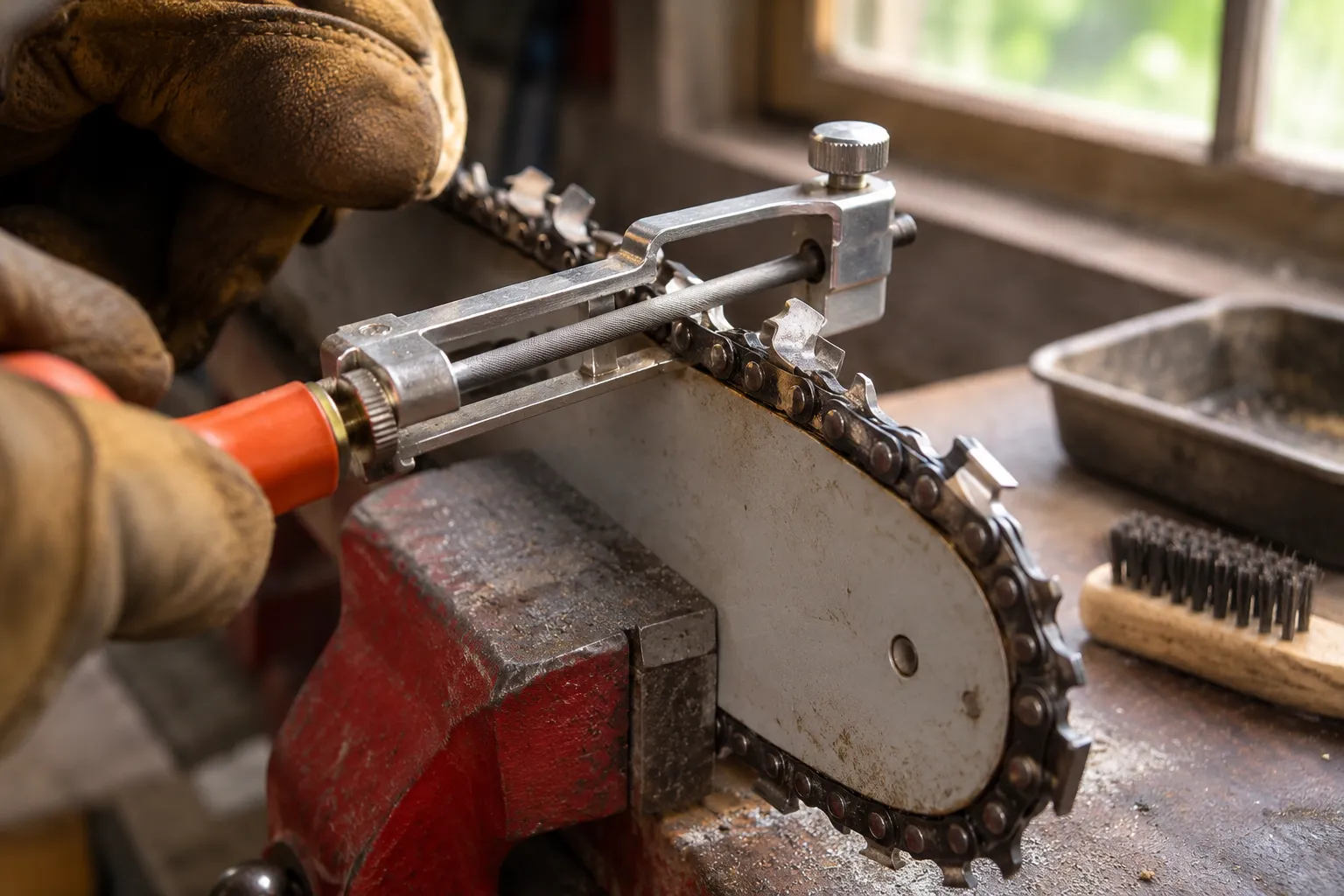
The Granberg clamps onto your guide bar and holds a standard round file at a fixed angle and height. You set it once, then every cutter gets the same stroke. That consistency is the whole point: freehand filing goes wrong when the angle drifts from tooth to tooth.
It is made of cast aluminum and zinc-plated steel with no plastic parts, weighs about 1.1 pounds, and is made in the USA. It adjusts for any pitch, angle and tooth height, and it accepts every common file size. Outdoor Life named it Best Overall among the chainsaw sharpeners it tested.
Good
- Works on any chain pitch with the matching file
- All-metal build that does not flex
- Needs no power, so it works in the woods
- Low running cost: replacement files are cheap
Not so good
- Files are sold separately
- Setup takes a few minutes the first time
- Slower than a grinder if you have a pile of chains
Buy it if you own one or two saws and want sharp, even cutters without paying for a grinder.
2. Timberline Chainsaw Sharpener: most consistent by hand
The Timberline also clamps to the bar, but instead of a file it uses a tungsten carbide cutter that you turn with a hand crank. Two hand knobs lock the machined aluminum body in place, the cutter is guided at a fixed 30° angle, and you pull the chain through one tooth at a time. Each cutter is trimmed to the same length and shape.
Kits run roughly $155 to $185. Carbide cutters are sold by size, at about $25 to $28 each, in 5/32”, 3/16”, 13/64” and 7/32”. All sizes fit the same body, so adding a second saw only means buying another cutter. One seller rates the carbides for at least 40 sharpenings.
Good
- Very uniform cutters with little skill required
- Fast once it is set up
- No power needed
- One body covers every chain size
Not so good
- Expensive for a hand tool
- A separate carbide is needed for each file size
- The fixed 30° guide does not suit chains that call for a different angle
Buy it if you have struggled to get even results with a file and are willing to pay to remove the guesswork.
3. Oregon 410-120: best bench grinder
If you run several saws or sharpen for friends and neighbors, a bench grinder is the fastest route. The Oregon 410-120 mounts to a bench or a wall, runs on a 120V motor at 3,150 RPM with a 5-3/4” grinding wheel, and handles chains up to .404” pitch. Bob Vila rated it 4.8 out of 5 and named it Best Overall after testing eight sharpeners.
Prices vary a lot between retailers, from about $220 to $300, so it is worth comparing before you buy.
Good
- Fastest way to sharpen a stack of chains
- Restores badly damaged cutters that a file would take ages to fix
- Repeatable angle and depth settings
Not so good
- The chain has to come off the saw
- Costs more than every hand option
- Takes practice: too much pressure overheats the cutter and softens the steel
Buy it if you sharpen often enough that time matters more than price.
4. Oregon Sure Sharp 575214: best budget powered option
The Sure Sharp is a handheld 12V grinder that runs from a vehicle battery. It comes with three sharpening stones (5/32”, 3/16” and 7/32”), a vehicle power adapter, alligator clips and a cord of about 16 feet. At roughly $43 to $61 depending on the retailer, it is the cheapest way to get a powered sharpener.
Good
- Inexpensive
- Sharpens on the saw, at the truck
- Three stone sizes included
Not so good
- You control the angle by hand, so results depend on your steadiness
- Stones wear and need replacing
- Easy to remove too much metal
Buy it if you want something quicker than a file for field touch-ups and do not mind a learning curve.
5. Stihl 2-in-1 Easy File: best for quick touch-ups
The 2-in-1 holds two round files and a flat file in one frame. As you file the cutter, the flat file lowers the depth gauge at the same time, which is the step most people skip. It is sold by chain size, including 1/4”, 3/8” P (4.0 mm), .325” (4.8 mm) and 3/8” (5.2 mm), so you need the version that matches your chain. Ace Hardware lists it at about $50.
Good
- Sharpens the cutter and sets the depth gauge in one pass
- Small enough for a pocket
- Very quick for a mid-day touch-up
Not so good
- Each tool fits only one chain size
- Less precise than a bar-mounted guide
- Will not rescue a chain that has hit a rock
Buy it if you want to keep an already decent chain sharp between tanks of fuel.
How to choose a chainsaw sharpener
Match the tool to how much you sharpen
- One saw, a few cords a year: a bar-mounted file guide or a 2-in-1 file is plenty.
- Two or three saws, regular use: a Timberline or a bar-mounted guide keeps results even without much effort.
- Many chains, or chains that see dirty wood: a bench grinder saves real time.
Know your chain size first
Every sharpener has to match your chain. The pitch is usually stamped on the guide bar or printed on the chain box. Typical file sizes are:
| Chain pitch | Typical round file |
|---|---|
| 1/4” | 5/32” (4.0 mm) |
| 3/8” low profile | 5/32” (4.0 mm) |
| .325” | 3/16” (4.8 mm) |
| 3/8” | 7/32” (5.5 mm), or 13/64” (5.2 mm) on many Stihl chains |
| .404” | 7/32” (5.5 mm) |
Some chains are exceptions, so check the chain manufacturer’s chart before you buy files or stones.
On the saw or off the saw
Files, the Timberline and 12V grinders sharpen with the chain on the bar. Bench grinders need the chain removed. If you sharpen in the woods, that settles the choice.
Do not forget the depth gauges
The small ramp in front of each cutter, the depth gauge or raker, controls how big a bite the cutter takes. As cutters get shorter, the gauges need lowering too, or a freshly sharpened chain still will not cut well. Check them every three to five sharpenings with a depth gauge tool and a flat file, and follow the setting given for your chain (commonly .025”).
Bottom line
For most people cutting their own firewood, the Granberg File-N-Joint G-106B is the best chainsaw sharpener: it is accurate, durable, works on every chain, and costs about the same as two new chains. Step up to the Timberline if you want near-foolproof consistency, or to the Oregon 410-120 if you sharpen enough chains that speed is what counts.
Common questions
How often should I sharpen a chainsaw chain?
Sharpen when the saw produces fine dust instead of chips, when you have to push to make it cut, or when the cut pulls to one side. Many users touch up the chain every time they refuel.
Is an electric sharpener better than a file?
An electric grinder is faster and better at repairing damaged cutters. A file removes less metal, so the chain lasts longer, and it needs no power. For most homeowners a guided file gives the better result for the money.
What angle should I sharpen at?
Many chains use a 30° top-plate angle, but it varies by model. Some call for 25°, 35° or 10°. Use the angle listed by the chain manufacturer when you can find it.
Can I sharpen a chain without taking it off the saw?
Yes. File guides, the Timberline and handheld 12V grinders all work with the chain on the bar. Only bench grinders require removing it.
When is a chain too worn to sharpen?
Replace the chain when the cutters are filed back to the wear line stamped on the top plate, when cutters are cracked or missing, or when the chain no longer holds tension.