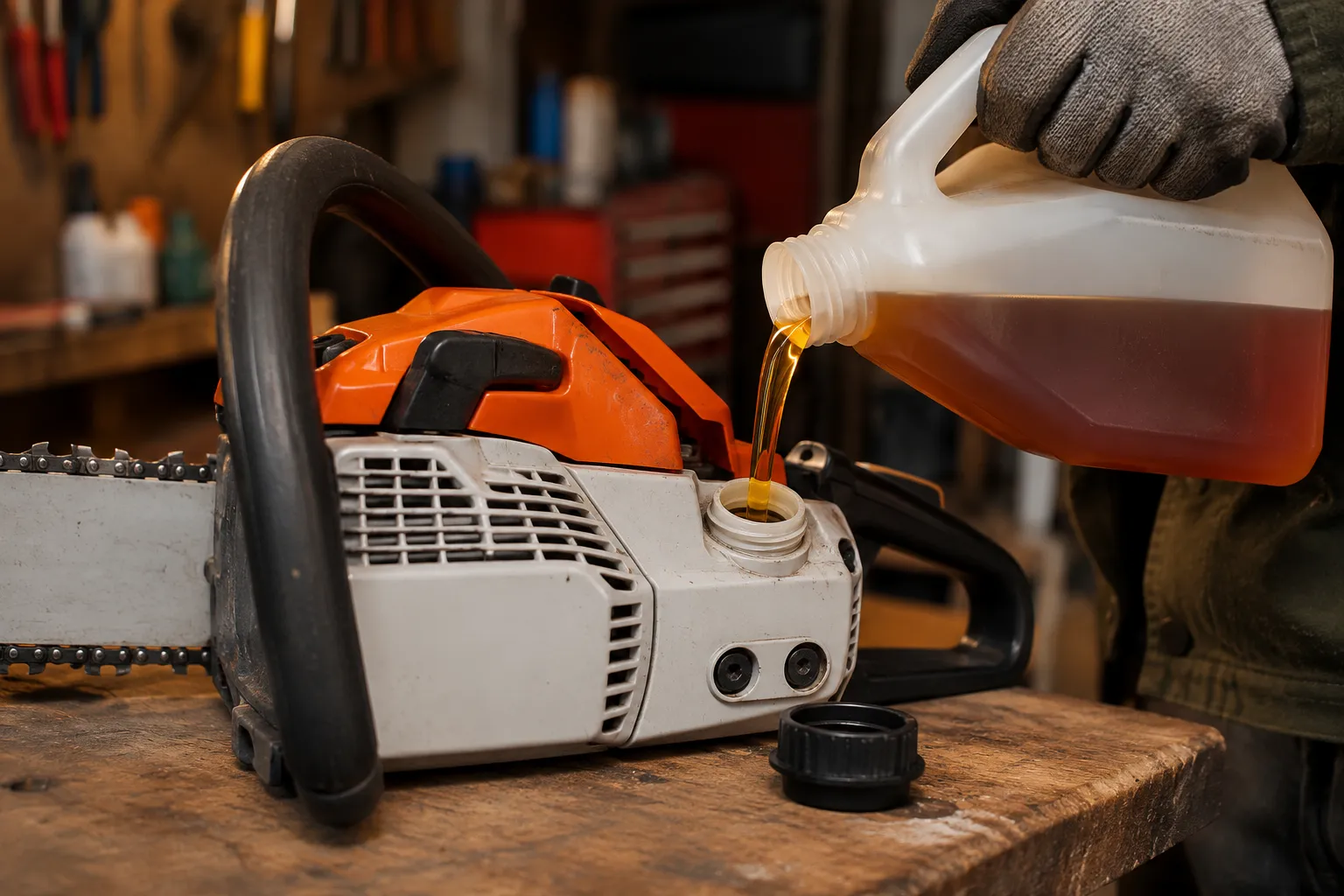
Every chainsaw is a total-loss oiling system. The pump drips oil onto the bar, the chain carries it around, and most of it ends up as a fine film on the log and the ground. Run the tank dry and the bar and chain heat up fast, which is how a good chain turns blue and a bar gets ruined in a single afternoon.
That makes bar and chain oil the one consumable you use at nearly the same rate as fuel. It is not expensive, but the choices are confusing: all-season, winter grade, biodegradable, and the old temptation to pour in whatever motor oil is in the garage.
This guide covers what makes bar oil different, how fast a saw uses it, and five widely sold options. It is based on manufacturer pages, owner’s manuals and retailer listings. Prices are approximate and were checked in November 2026.
Quick comparison
| Oil | Base | Approx. price (1 gal) | Cold rating | Best for |
|---|---|---|---|---|
| Stihl Woodcutter | Petroleum | $22 to $24 | Not stated; Stihl sells Winter Grade | Stihl owners, general use |
| Husqvarna X-Guard All Season | Petroleum | About $28 | Down to 15°F | Year-round use, tackifier |
| Echo Premium Bar and Chain Oil | Petroleum | $20 to $24 | Not stated | Lowest cost from a saw maker |
| Oregon Premium 54-059 | Petroleum | $19 to $34 | “All season,” no number | Cheap, widely stocked |
| Stihl BioPlus | Vegetable | About $40 | Not stated | Cutting near water or sensitive ground |
What bar oil does that motor oil does not
A chain moves at very high speed, and centrifugal force pulls oil off it. Bar oil has a tackifier added so it forms sticky strings that cling to the chain. Husqvarna says its X-Guard oils use a premium tackifier for exactly this reason, and Oregon says its oil is compounded for extra tackiness to resist throw-off.
Motor oil is designed for a sealed engine, where it never has to stay on a surface moving at that speed. In a saw it flies off faster, so you burn through more of it and the bar gets less protection.
Used motor oil is worse. Husqvarna’s support page advises against waste engine oil for bar and chain lubrication and lists the reasons: it lacks tackifiers, it often carries small particles that wear the oil pump, it can attack rubber parts, and it can contain combustion by-products and heavy metals. Guidance on fresh motor oil differs between makers, so read your manual. The cost difference at the pump is small compared with a replacement oil pump or bar.
How fast a saw uses oil
There is no single number. Husqvarna says its oil pumps deliver between 8 and 50 ml per minute depending on the model, and many saws let you adjust the output.
A common rule of thumb is about one tank of oil for each tank of fuel. That is a forum saying, not a maker’s specification, and newer saws often use less. What manuals do say is that the tanks are sized to run down together: Stihl’s MS 193 manual states that a small amount of oil should still be in the oil tank when the fuel tank is empty. So the practical test is simple. Fill both tanks, and if the oil level is barely moving after a full tank of fuel, the saw is not oiling properly. Check the oiler, the oil passages and the bar groove, and see the maintenance checklist.
1. Stihl Woodcutter: best for Stihl owners
Woodcutter is Stihl’s standard petroleum bar and chain oil, sold in quart and gallon bottles. Retailers list the gallon at roughly $22 to $24, and some stores sell it for in-store pickup only.
The listings do not give a cold-weather range. Stihl sells a separate Winter Grade oil for freezing temperatures, so if you cut firewood through the winter, use that instead of guessing.
Good
- Priced about the same as other brand-name oils
- Quart size is handy for a single day of cutting
- A winter-grade companion product exists from the same maker
Not so good
- No cold-weather rating on the standard oil
- Some stores sell it in person only
Buy it if you run Stihl saws and want the maker’s matching oil at a fair price.
2. Husqvarna X-Guard All Season: best all-season oil with a stated range
X-Guard All Season is sold in quart and gallon bottles and in a 55-gallon drum. Husqvarna lists a premium tackifier additive, anti-wear additives and virgin base stocks, and rates it for use down to 15°F (minus 9°C). Tractor Supply lists the gallon at $27.99. The company also sells a Low Temp version rated to minus 15°F.
Good
- Published temperature rating
- Tackifier and anti-wear additives named by the maker
- Low Temp version available for hard winters
Not so good
- Costs a few dollars more per gallon than Echo or Oregon
- Retailer listings disagree on how to describe the base oil
Buy it if you cut in a range of temperatures and want a maker’s rating instead of the word “all-season.”
3. Echo Premium Bar and Chain Oil: lowest cost from a saw maker
Echo’s 1-gallon Premium oil (part 6459007) is described for gas and battery chainsaws and pole saws. Most retailers list it between $20 and $24, and one seller offers a 4-gallon case at about $89.76, or roughly $22 a gallon.
Good
- Cheap for a name-brand oil
- Works in gas and battery saws and pole saws
- Case pricing helps if you cut a lot
Not so good
- No cold rating published in the listings
- Fewer details on additives than Husqvarna gives
Buy it if you run an Echo and want a dependable oil without paying extra for the label.
4. Oregon Premium 54-059: the cheap, everywhere option
Oregon’s 1-gallon Premium Bar and Chain Oil is sold through dealers and hardware stores. Oregon calls it all-season, compounded for extra tackiness, and resistant to pitch, sap and gum buildup. Prices run from about $19 to $34 depending on the retailer, so shop around. Oregon’s page gives no numeric temperature range.
Good
- Often the cheapest gallon on the shelf
- Fits any saw brand
- Stocked at most farm and hardware stores
Not so good
- Big price swings between sellers
- No stated temperature range
Buy it if you want the lowest price and run your saw in mild weather.
5. Stihl BioPlus: best biodegradable pick
BioPlus is a vegetable-oil-based lubricant. Retailer listings describe it as 93.8 percent biodegradable in 21 days and price the gallon at about $40, roughly double the petroleum oils above. That matches a general pattern: the Forest Service has noted that vegetable-based chain oils tend to cost about twice as much as petroleum ones.
Husqvarna also sells a vegetable-based X-Guard Biodegradable oil, rated down to 0°F and described as biodegrading within 28 days. Milwaukee sells one too. If you go this way, check the temperature rating, because plant oils can behave differently in the cold.
Good
- Vegetable base for cutting near water or on land you want to protect
- Biodegradation claim stated on retailer listings
Not so good
- About twice the price per gallon
- No cold rating on the listings checked
Buy it if you cut near streams, in a woodlot, or on ground where oil buildup matters to you.
How to choose bar and chain oil
Match the oil to the temperature
Cold thickens oil and can slow its flow to the bar. In freezing weather use a winter-grade or low-temperature product such as Stihl Winter Grade or Husqvarna Low Temp. In summer a standard all-season oil is fine, and the maker’s rating is your guide.
Decide whether biodegradable matters to you
If your saw runs on a lot where oil lands in the soil or near water, a vegetable-based oil is a reasonable step. Otherwise a petroleum oil from a saw maker does the job for far less.
Buy by the gallon
A gallon costs far less per ounce than quarts. Keep it sealed and clean, and wipe the cap before pouring so grit does not get into the tank. Always top up oil before a job, as Husqvarna notes that overfilling after use can cause seepage.
Keep the oiler working
The best oil does nothing if the pump or the bar groove is clogged. Your manual describes how to check oil flow, and most call for running the saw with the tip held a short distance above a light surface and looking for a fine line of oil. Follow your manual’s method exactly. If you see no oil, stop and clean the oil passages. Fuel is a separate question: the right 2-stroke mix is covered in our 2-stroke oil guide, and you can work out ratios with the fuel mix calculator.
Bottom line
For most homeowners, the right answer is the maker’s bar oil that matches the season: Husqvarna X-Guard All Season if you want a published temperature rating, Echo Premium or Oregon 54-059 if price is the priority, and Stihl BioPlus if the ground you cut on matters. Skip the motor oil. The savings are tiny, and the chain, bar and oil pump pay for it.
Common questions
Can you use motor oil for bar oil?
It is not a good idea. Bar oil contains a tackifier so it clings to a fast-moving chain, and motor oil does not, so more of it flings off. Husqvarna specifically advises against used engine oil, because it can hold particles that wear the oil pump and contaminants that are harmful to handle. Check your saw's manual before substituting anything.
How much bar oil does a chainsaw use?
It depends on the saw and the oiler setting. Husqvarna says its oil pumps deliver between 8 and 50 ml per minute depending on the model. The oil and fuel tanks are generally sized to run down together, and a Stihl manual says a small amount of oil should still be in the tank when the fuel tank is empty. If your oil level barely moves, check the oiler.
What is tackifier in bar oil?
It is an additive that makes the oil stringy and sticky so it stays on the bar and chain instead of being thrown off by the speed of the chain. Husqvarna describes its tackifier as creating longer-lasting strings of oil on the chain.
Do I need a different bar oil in winter?
In cold weather standard oil can thicken. Stihl sells a separate Winter Grade bar oil, and Husqvarna rates its All Season oil down to 15 degrees F and its Low Temp oil down to minus 15 degrees F. In hot weather, a thinner oil can sling off faster, so follow the oil maker's temperature guidance.
Is biodegradable bar oil worth the extra cost?
It can be if you cut near streams, in a woodlot you care about, or on land where oil on the ground is a concern. Chain oil is a total-loss system, which means nearly all of it ends up on the ground, so what it is made from matters. Expect to pay roughly double the price of petroleum oil.