A chainsaw does not need much, but it needs the same things on a steady rhythm. Most maintenance comes down to a sharp chain, correct tension, oil reaching the bar, and clean air and cooling. The tables below sort the work by how often it comes up, from every use to once a year.
This schedule is built from the maintenance sections and support pages of Stihl, Husqvarna and Echo. It is a general schedule, not a replacement for your saw’s manual. The makers do not agree on every interval, and the differences are noted below.
How to use this schedule
Switch the saw off and make sure it cannot start before any hands-on job. On a gas saw, let it cool and pull the spark plug boot. On a battery saw, remove the battery. Wear gloves around the chain.
Makers also say their charts assume normal conditions. Stihl’s chart says to shorten intervals in difficult conditions, such as very dusty or resinous wood, and to lengthen them for occasional use. If you cut dirty wood or work long days, move jobs one column to the left.
Before every use
| Check | What to look for | If it fails |
|---|---|---|
| Chain sharpness | Chips, not fine dust. Cutters undamaged | Sharpen it |
| Chain tension | No sag, still pulls around by hand (how tight) | Adjust, with the chain cold |
| Chain brake | Engages and releases cleanly. Test it per your manual | Stop. Dealer repair |
| Bar oil level | Tank has enough for the day | Refill (bar oil guide) |
| Controls | Throttle lockout, trigger and stop switch work | Dealer repair |
| Handles and covers | Tight, undamaged, no cracks | Tighten or replace |
| Fuel and oil caps | Seated and sealing | Replace worn caps |
The brake test matters most. If it does not stop the chain, do not use the saw. Our kickback guide explains what the brake does and what it does not.
At every refuel
| Check | Why |
|---|---|
| Re-check chain tension | The chain stretches as it warms, and a new chain stretches the most |
| Top up bar oil | Check the level every time rather than assuming it matches the fuel |
| Touch up the chain | Many users give the chain a few file strokes at each fill |
| Brush the cooling air intake | Husqvarna says to check and clean the air filter at every refuel in demanding conditions |
| Look for fuel leaks | Wet spots around the cap or lines mean a problem |
Mix fresh fuel in the right ratio. The fuel mix calculator does the math, and Stihl’s guidance is to treat pump gasoline as stale after about 30 days.
Daily or after use
| Job | Detail |
|---|---|
| Clean the bar groove and oil hole | Packed sawdust blocks oil flow. Use a groove cleaner or a thin screwdriver, per how to clean a chainsaw |
| Clean the sprocket area | Remove the side cover and clear the chips |
| Clean the air filter | Husqvarna says to clean it daily after use. Stihl says to clean it regularly |
| Clean the cooling fins and air intake | Stihl’s chart lists both the fan housing intake and the cylinder fins |
| Check the chain catcher | A bent or cracked one needs replacing |
| Wipe the saw down | Resin and oil attract dirt |
Weekly, or every few tanks
| Job | Detail |
|---|---|
| Deburr and clean the bar rails | A bar dressing tool or flat file removes burrs. Stihl’s chart lists deburring |
| Flip the bar | Turning it over evens out rail wear. Many users do it at each chain change or sharpening. Your manual sets the interval |
| Check the bar for wear | Look for spread or pinched rails, a worn groove, a damaged nose |
| Check the sprocket | Deep grooves where the drive links ride mean it is worn. Do not run a new chain on a worn sprocket |
| Check the spark plug | Remove it, look at the electrodes, and clean any carbon. The gap varies by model |
| Check the spark arrestor screen | Stihl’s chart lists checking or replacing the screen in the muffler |
| Tighten accessible screws | Stihl’s chart lists screws and nuts, apart from the adjusting screws |
Monthly
| Job | Detail |
|---|---|
| Replace or properly service the air filter | Replace it if torn, or if it will not come clean |
| Check the fuel filter | Look at the pickup body in the fuel tank. If it is dark or stiff, replace it |
| Check fuel lines and the primer bulb | Cracks and hardening are common with ethanol fuel |
| Inspect the clutch and drive area | Husqvarna’s schedules for other models list the drive gear and clutch as a monthly check |
| Check the anti-vibration mounts | Stretched, cracked or torn mounts make the saw feel rougher |
Yearly, or before storage
| Job | Detail |
|---|---|
| Replace the fuel filter | Stihl’s chart lists replacing the fuel pickup body. Yearly is a sensible default |
| Replace the spark plug | Per your manual. Stihl’s chart for one mid-size saw says 100 hours |
| Replace the air filter | Even a clean one ages |
| Dealer inspection | Chain brake, anti-vibration elements, carburetor idle adjustment and the clutch. Stihl’s chart lists several of these as dealer jobs |
| Prepare for storage | See how to store a chainsaw |
Where the makers differ
- Spark plug life. The Stihl and Husqvarna sources give very different numbers, 100 hours against about a month of operation. If you cut often, inspect the plug rather than going by hours.
- Air filter cleaning. Husqvarna’s support page says foam filters are washed in warm soapy water and pleated paper filters can be brushed or washed. Some Stihl manuals allow blowing dry dust out from the inside, while newer ones say not to dry with compressed air. Check your manual. The cleaning guide covers it.
- Bar oil in storage. Stihl and Husqvarna handle it differently. See the storage guide.
Battery saws: what still needs doing
| Still needed | Not needed |
|---|---|
| Chain sharpening and tension | Fuel mixing |
| Bar oil level, oiler check, groove cleaning | Spark plug |
| Bar rail deburring and flipping | Carburetor tuning |
| Sprocket wear check | Fuel filter and fuel lines |
| Chain brake test | Spark arrestor screen |
| Battery and charger contacts, wiped clean | Air filter on most models |
| Battery storage at partial charge | Storage draining |
Stihl’s cleaning page says to wipe the battery and charger with a damp cloth and brush the electrical contacts if needed. Keep the battery out of heat and cold extremes between uses. There is more in the electric saw guide.
Tools that make it easier
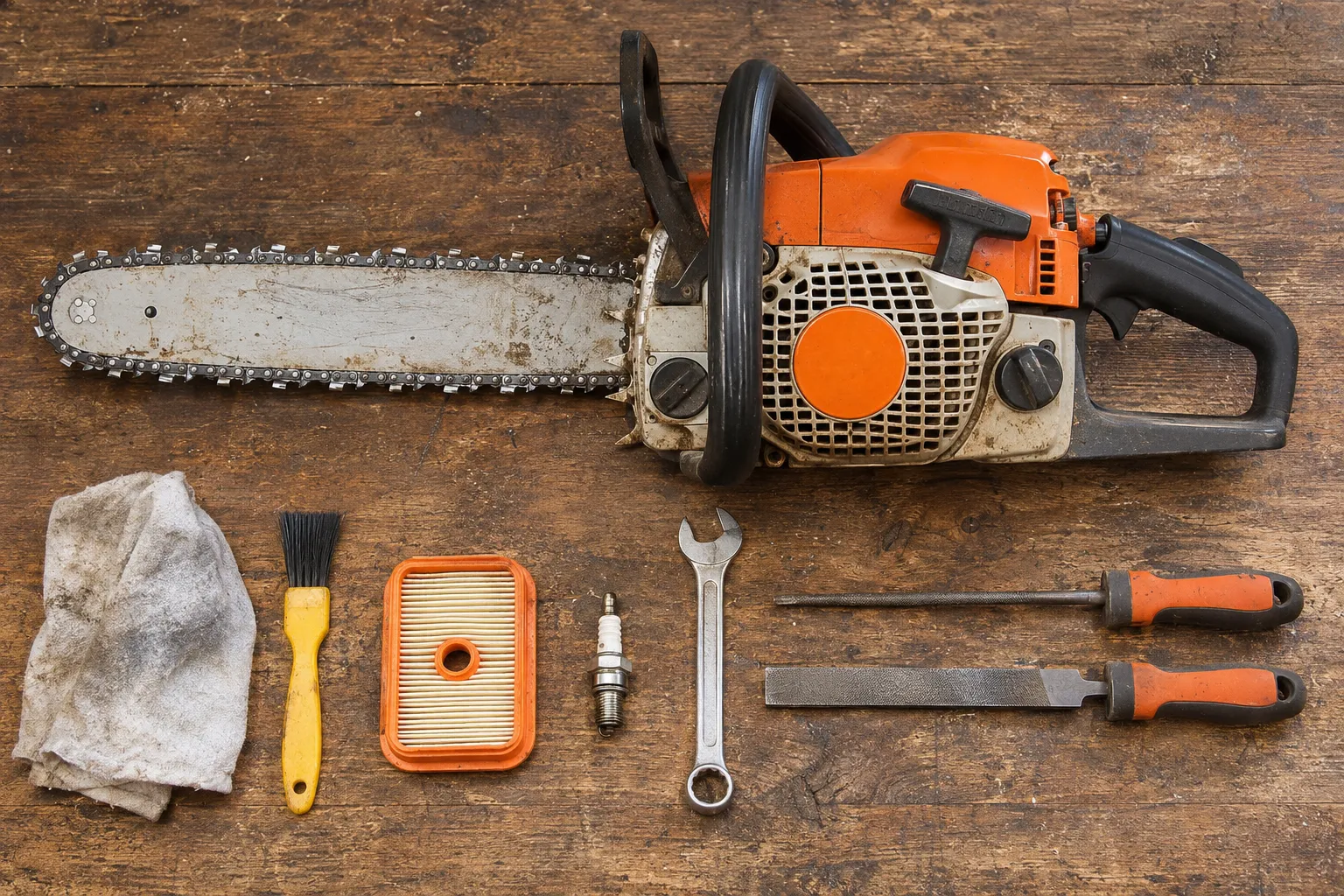
Most of this runs on a short list: a file guide or sharpener, a bar groove cleaner, a bar dressing tool, a scrench, a spare plug and filter, and good bar oil. The chainsaw accessories guide covers the rest, and a two-stroke oil guide helps with fuel. If a job turns into a puzzle, a dealer visit costs less than a ruined bar or piston.
Bottom line
Every use: sharp chain, correct tension, working brake, oil in the tank. Every day: clean the groove, filter and fins. Every month: plug, fuel filter, mounts. Every year: renew the wearing parts and prepare the saw for storage. When your manual’s interval differs from the one here, follow the manual.
Common questions
How often should I maintain my chainsaw?
Some checks happen every time you pick the saw up, such as chain sharpness, chain tension, bar oil level and the chain brake. The air filter, cooling fins and bar groove are daily jobs on a working day. Spark plug, fuel filter and sprocket checks run on a longer cycle. Stihl and Husqvarna both say their charts assume normal conditions and should be tightened for dusty or resinous work.
How often should I replace the spark plug?
It depends on the maker and the model. A Stihl maintenance chart for a mid-size saw lists replacement after 100 hours of operation, while a Husqvarna manual page for the 455 Rancher says about a month of operation or earlier if needed. Inspect the plug every time you service the air filter and replace it when the electrodes are worn or fouled.
Should I flip my chainsaw bar?
Yes. Stihl's maintenance chart lists cleaning and turning the guide bar over. Turning it spreads wear across both rails so they stay square. A common rule of thumb is every time you sharpen or change the chain, but your manual sets the interval.
Does a battery chainsaw need maintenance?
Less than a gas saw, but not none. You still need to keep the chain sharp and correctly tensioned, keep the bar oil topped up, clean the bar groove and oil port, check the chain brake and keep the battery and its contacts clean. There is no fuel, spark plug or carburetor to deal with.
What is the most skipped maintenance job?
The air filter and the cooling air intake are the usual ones. A clogged filter makes the engine run rich and lose power, and packed cooling fins let the engine overheat. Both take a few minutes with a brush.