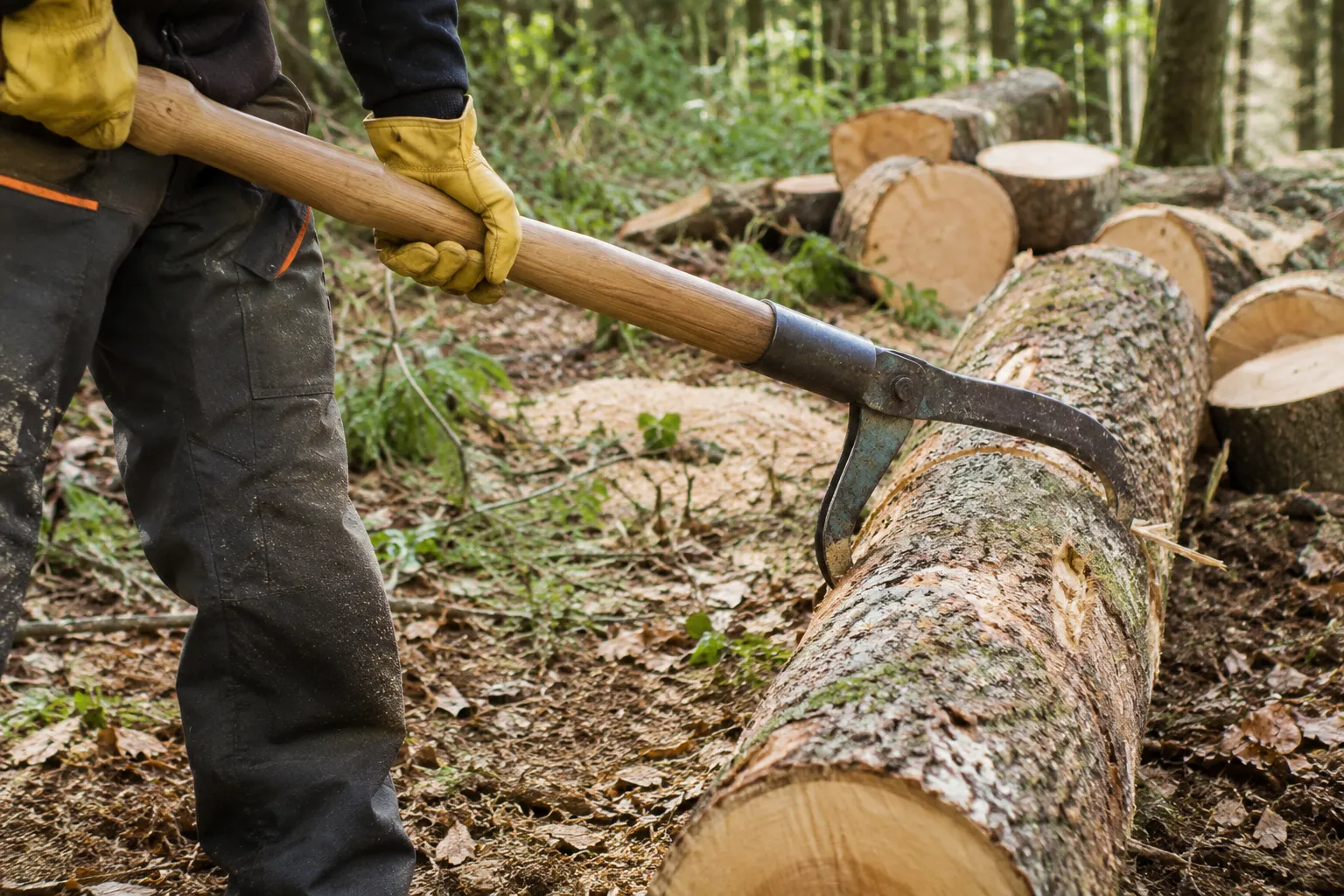
A cant hook is a long handle with a steel hook that bites into a log so you can roll it. It exists to solve one problem: moving a log that is too heavy to lift or turn by hand without wrecking your back. Without one, people bend over a 100-pound round and pull, or kick it, or pry it with the saw.
Three tools show up under this name, and they overlap. A cant hook has a hook and a blunt tip. A peavey has the same hook plus a spike at the end of the handle. A timberjack adds a foot that lifts a log off the ground. This guide explains when each is the right pick, then compares five real models.
The comparison relies on manufacturer pages, retailer listings and woodworking and sawmill sources. It is not based on hands-on testing. Prices are approximate and were checked in November 2026.
Cant hook vs peavey vs timberjack
| Tool | What is different | Best at |
|---|---|---|
| Cant hook | Blunt tip with a toe or extra teeth, no spike | Rolling a log in place |
| Peavey | Spike on the handle end | Dragging and levering a log along the ground |
| Timberjack | Hook with a foot or leg | Lifting a log off the dirt so it can be cut |
Wood-Mizer, which sells both, says the main difference is the tip. The peavey’s point can be stuck into the ground to slide or lever a log. The cant hook has no point, and a second biting edge instead. Both roll logs in the same way. Many cutters use the names interchangeably, so check the actual tool before you buy.
For a woodpile, a peavey or a combination tool is the flexible choice. For a log you are bucking in the yard, a timberjack saves you from cutting into the ground and dulling the chain. Wood-Mizer recommends owning at least two tools for basic log rolling.
Quick comparison
| Model | Type | Handle | Approx. price | Listed log size |
|---|---|---|---|---|
| LogRite 60” CH060 | Cant hook | Aluminum | $130 to $146 | 10” to 36” |
| Woodchuck W004 Dual | Peavey and cant hook | Aluminum, 48” | Check retailer | Check listing |
| Peavey Mfg 48” hardwood cant hook | Cant hook | Wood | About $213 | Check listing |
| Timber Tuff 4 ft cant hook | Cant hook | Wood | About $100 | Up to 12” to 14” |
| Timber Tuff steel timber jack | Timberjack | Steel | About $50 | Check listing |
1. LogRite 60” cant hook (CH060): best overall
LogRite is a US maker that sells cant hooks in 24”, 30”, 42”, 48” and 60” lengths. The standard 60” model has an aluminum handle about 1.75” across, a heat-treated zinc-plated hook and a textured rubber grip. Retailers list it at about 9.95 pounds and made in the USA, and rate it for logs from 10” to 36” in diameter. The 48” version is listed for 8” to 32”. Prices run about $130 to $146 at dealers like Bailey’s and Arborwear, and LogRite also sells an Xtreme Duty line and a fiberglass-handled 60” at about $194.
Good
- Wide size range, so you can match the handle to your logs
- Aluminum handle does not rot
- Rubber grip helps with control
Not so good
- 60” is long for small firewood rounds
- Costs more than a basic wood-handled hook
Buy it if you roll large logs and want a long-lasting tool that does not need handle upkeep.
2. Woodchuck W004 Dual: best two-in-one
Woodchuck’s W004 is a 48” aluminum tool, listed at about 9.5 pounds, with a retractable peavey point. It switches between peavey and cant hook modes, and carries a lifetime guarantee, according to Power Equipment Direct. Woodchuck also lists a DualPro that adds a timberjack-style foot, rated to lift logs from 5” to 20” and roll logs up to 30”, per a Walmart listing. Pricing was not confirmed, so check current listings.
Good
- Peavey and cant hook in one tool
- Retractable point is safer to store and carry
- DualPro version adds log lifting
Not so good
- More moving parts to wear
- Specs differ by version, so read the listing carefully
Buy it if you want one tool for both rolling and dragging and do not want to buy a peavey and a cant hook separately.
3. Peavey Manufacturing hardwood cant hook: best traditional
Peavey Manufacturing, in Eddington, Maine, builds the tool the word “peavey” is named for. Its cant hook has a forged carbon-steel head on a hardwood handle. A Lee Valley listing describes a 48.5” overall length with an ash handle, a 2-1/4” tapered socket and a steel screw. A 60” model (T-029-060-0176) is listed at about 9 pounds with a 16” hook opening for logs up to 36”. A 48” hardwood version is around $213 at Zoro. Replacement ash handles are sold separately, at roughly $63 to $71 from Lee Valley.
Good
- Forged head and a handle you can replace
- Long pedigree, and parts are available
- Wood is comfortable in cold weather
Not so good
- Highest price of the group
- Wood needs dry storage and the occasional new handle
Buy it if you want a tool you can keep for decades and repair with a new handle.
4. Timber Tuff 4 ft cant hook: best budget
Tractor Supply lists Timber Tuff’s 4-foot wood-handled cant hook at about $99.99. It has a powder-coated hook and a listed capacity of up to 14” logs. One Do it Best listing gives 12”, and a Zoro listing marks the item discontinued, so check stock and specs before ordering. It is a short-handled tool aimed at firewood-size logs.
Good
- Lower price than LogRite or Peavey
- Handle length suits firewood rounds
- Wood handle is easy to replace
Not so good
- Listed capacity is limited, 12” to 14”
- Stock and specs vary by retailer
Buy it if your logs are mostly under a foot across and you want the cheapest sensible entry.
5. Timber Tuff steel timber jack: best for lifting logs
A timberjack lifts one end of a log so you can cut without hitting the ground. Tractor Supply lists a Timber Tuff steel-handle timber jack (item 3990131) at about $49.99. It is the least expensive way to get a log off the dirt, though it does not roll logs as well as a good cant hook.
Good
- Lowest price here
- Keeps the chain out of the dirt and lowers the chance of a pinched bar
- All-steel handle
Not so good
- Not as good at rolling as a cant hook
- Heavier to carry than aluminum
Buy it if your problem is cutting logs that sit on the ground rather than moving them.
How to choose a cant hook
Match handle length to log diameter
Longer handles give more leverage, which helps with big, heavy logs. Shorter ones are easier to use on logs raised on a stand or splitter. LogRite’s ratings give a rough guide: the 48” is listed for 8” to 32” logs and the 60” for 10” to 36”. For firewood rounds under a foot, a handle in the 36” to 48” range is enough.
Wood, aluminum or steel
- Wood (ash or hickory): traditional, replaceable, needs dry storage.
- Aluminum: does not rot or splinter; most LogRite and Woodchuck models use it.
- Steel: used by Wood-Mizer on its 48” cant hook, and by Timber Tuff on its timberjack. It is built to take abuse, though steel is typically heavier.
Safety
Rolling a log is dangerous on a slope, because it can come back at you. Chock the log, keep your feet clear of its path and use a gentle pull. A cant hook moves logs but does not make heavy lifting risk-free. Wear boots and gloves, as covered in what to wear when using a chainsaw.
Pair it with other tools
A cant hook works well with a sawbuck and with log tongs. See the best log tongs for lifting firewood by hand, how to buck a log for cutting, and chainsaw accessories for the wider kit.
Bottom line
For most people who handle logs, the LogRite 60” CH060 is the best cant hook: a long-lasting aluminum tool with a wide size range. If you want a hook that doubles as a peavey, the Woodchuck W004 Dual is the pick. Go with the Peavey Manufacturing hardwood hook for a lifetime tool, and buy the Timber Tuff timber jack if you only need to lift logs off the ground.
Common questions
What is the difference between a cant hook and a peavey?
A peavey has a metal spike at the end of the handle and a hook that swings on the shaft. A cant hook has a blunt end with a toe or extra teeth instead of a spike. Both roll logs the same way. The peavey's point also lets you dig in and lever a log along the ground.
What is a timberjack?
A timberjack is a cant hook or peavey with a foot or leg that lifts one end of a log off the ground so the saw does not hit dirt. On many models the foot is removable, so the tool also works as a plain cant hook.
What length cant hook do I need?
A longer handle gives more leverage for heavy, large logs. A 36-inch to 48-inch handle suits most firewood rounds. LogRite lists its 48-inch aluminum hook for 8 to 32 inch logs and its 60-inch for 10 to 36 inch logs.
Is an aluminum handle better than wood?
Aluminum does not rot or splinter and is easy to keep outdoors. Wood is traditional, feels less cold and can be replaced with a new handle, since ash replacements are sold for Peavey tools. Pick the one you will keep in good repair.
Is a cant hook safe to use on a slope?
Rolling logs on a slope is risky because a log can get away from you. Chock the log, stay uphill and out of the roll path, and move to level ground if you can.