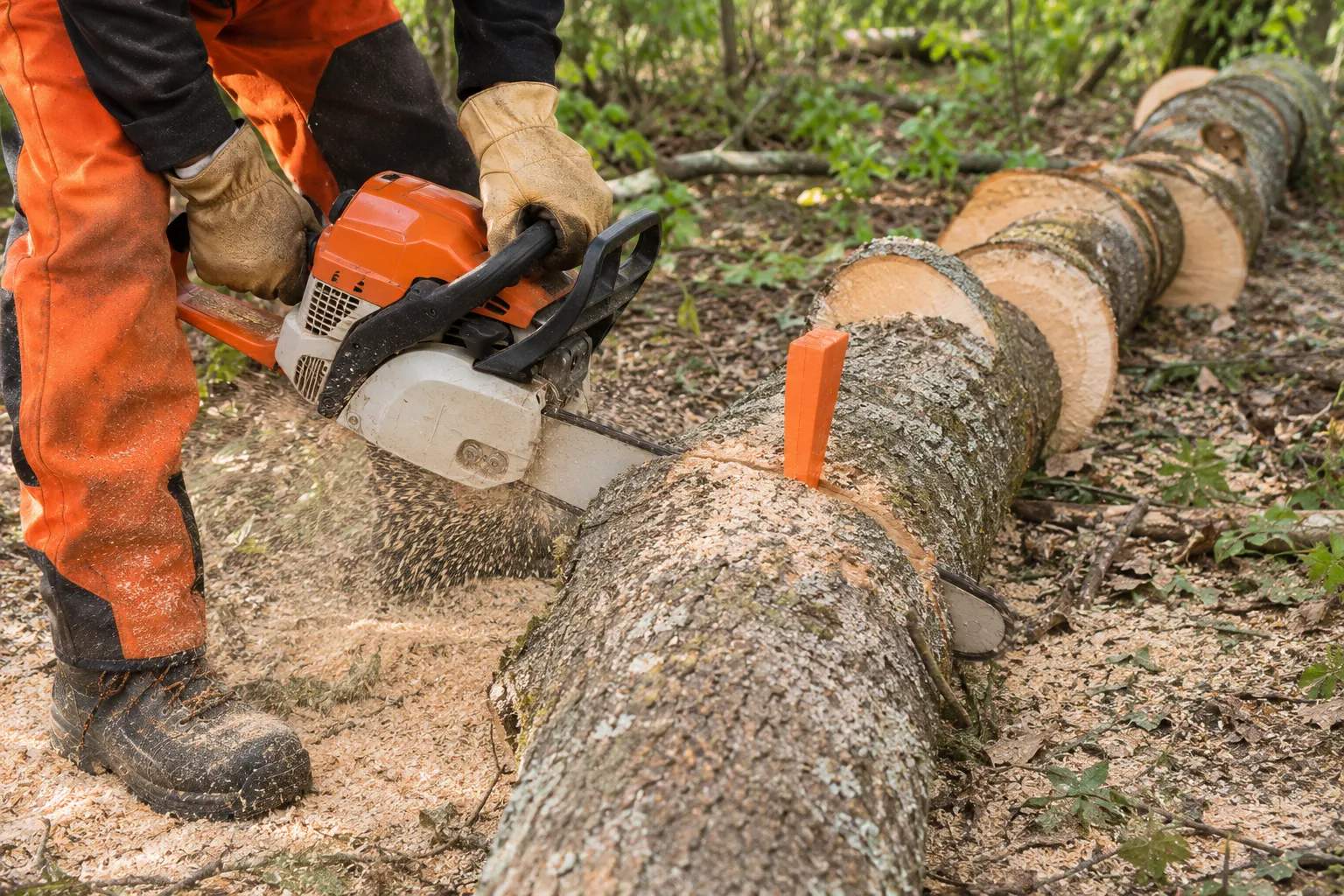
Read how the log is held, then cut the side that is being squeezed first and finish from the side that is being stretched. That order keeps the wood from closing on the bar. The details change a little depending on whether the log is supported at both ends, at one end or along its whole length.
This guide is based on extension service and Forest Service guidance, OSHA’s logging materials and tool makers’ listings. It is a summary, not a replacement for your saw’s manual and for hands-on training. Wear the right gear for any chainsaw work, as covered in what to wear when using a chainsaw.
Before you cut
- Plan each cut. The Forest Service advises looking at escape route, slope, tension, compression and overhead hazards before the first cut.
- Stand uphill of the log. Wisconsin and Purdue extension guidance say to stand on the uphill side on slopes, with solid footing and a clear path away if the log rolls.
- Cut at full throttle, keep both hands on the saw, and never cut above shoulder height. Keep the upper nose of the bar out of the wood. See chainsaw kickback.
- Check the chain. A sharp, correctly tensioned chain pinches less often and cuts without pushing. See how tight should a chain be.
- Cut one log at a time, and check the wood for nails, wire and dirt.
Read tension and compression
A log that is not lying flat on the ground is bent by its own weight. The Forest Service explains that wood under compression is being pushed together, and wood under tension is being pulled apart, and that when one part of a log is under tension, another part is under compression. When the saw cuts compressed wood, the cut tries to close and grips the bar. When it cuts wood under tension, the cut tries to open.
| Log support | Compression side | Tension side |
|---|---|---|
| Both ends supported, middle free | Top | Bottom |
| One end supported, other end hanging | Bottom | Top |
| Supported along its whole length | Neither one, in general | Neither one |
| Log lies across a hump, ends hanging | Bottom | Top |
Forces shift as you cut, so look again after every cut. The Wisconsin extension forestry program advises re-checking tension and compression after each cut.
The cut order
Log supported at both ends
- Overbuck first. Cut down from the top about one third of the way through the log. The top is the compression side, so this relieves it.
- Then underbuck. Cut up from the bottom to meet the first cut, going through the lower two thirds.
Log supported at one end
- Underbuck first. Cut up from the bottom about one third of the way through. The bottom is the compression side.
- Then overbuck. Cut down from the top to meet the first cut.
Purdue Extension gives the same one-third and two-thirds sequence, and the Wisconsin extension guidance describes it as cutting the compression side first and finishing on the tension side.
Log supported along its whole length
Cut down from the top. If the log is on the ground, see below.
If the saw still pinches
Stop the saw and set the brake. Do not pull on a stuck saw with the chain running. Drive a plastic or wooden wedge into the cut above the bar to open it, then restart and finish. Wedges are covered in our best felling wedges guide. Use plastic or wooden wedges for this, because a chain that hits a metal wedge can be ruined.
Keep the chain out of the dirt
Dirt and grit dull a chain in a few seconds. To avoid it:
- Raise the log. Lay it across other logs or a sawbuck before cutting. Purdue advises lifting the log off the ground with limbs, logs or chocks when possible.
- Cut most of the way, then roll. If a log must stay on the ground, cut about two thirds of the way through, roll it with a cant hook and finish from the other side. This is a common technique, but check the log for stability first.
- Ease off as the bar nears the ground. Slow down for the last inch of the cut so the chain does not plunge into the dirt.
Roll and hold the wood
A cant hook is a pole with a swinging hook that turns a round log. It lets you roll a log to cut from the other side, or flip it onto supports without bending over. Read best cant hook for models. A timberjack is a related tool that lifts a log off the ground so the bar can pass through without touching dirt.
Always roll the log away from your feet and keep yourself uphill of it. Never reach under a log that is held up on a jack or a hook.
Cutting to stove length with a marking stick
Firewood that is the wrong length will not fit the firebox and gets recut, so measure before you cut.
- Measure the longest piece your stove or fireplace takes and subtract two or three inches. Many stoves take 16 inch wood, but check.
- Cut a straight branch or a piece of lath to that length. This is your marking stick.
- Lay the stick along the log and mark each cut with a lumber crayon, a spray marker or a notch from the saw.
- Mark a few cuts ahead before you start, so you can plan the order with tension and compression in mind.
- Cut a test round and check it in the stove before you cut a whole log.
If you want the volume of wood you will produce, our cord of wood calculator does the math.
Working on a sawbuck
A sawbuck is an X-shaped frame that holds a log or several small logs at a comfortable height. It raises the wood off the ground, which keeps the bar out of dirt and lets you stand upright, with your back straight and the saw in front of you. It is best for logs up to about the width of the frame. See best sawbuck for options.
How to use one:
- Set the sawbuck on firm, level ground.
- Lay the log across the crossed rails and make sure it cannot roll.
- If the cut falls between the rails, the log is supported on both sides, so use the both-ends order: overbuck a third, then underbuck.
- If the cut falls beyond the frame and the offcut hangs free, use the one-end order: underbuck a third first, then overbuck.
- Keep your feet and free hand well out of the way of the falling piece.
A short offcut that drops mid-cut can pinch the bar. Where you can, support both pieces so neither one drops until the cut is done.
Troubleshooting and mistakes
| Problem | Likely cause | Fix |
|---|---|---|
| Saw gets stuck partway through | Compression side was cut last | Stop, set the brake, wedge the cut, finish from the other side |
| Log splits with a loud crack at the end | Tension side was cut first | Cut the compression side first next time |
| Chain dull after one day | Cutting into dirt or stone | Raise the log, rotate the cuts, sharpen |
| Rounds all differ in length | No marking stick | Cut and use one |
| Saw rides up and kicks | Upper nose touched wood | Review chainsaw kickback |
| Log shifts while cutting | Not chocked or supported | Chock it, use a cant hook or a sawbuck |
Other mistakes to avoid:
- Cutting while standing downhill of a log that can roll.
- Making the last cut with the bar tip buried in the ground.
- Trying to free a stuck saw with the engine running.
- Bucking a log that is under heavy tension, such as a bent tree held by another tree. Leave it for a professional.
- Working alone without a phone.
After bucking
Split and stack the rounds soon. Our best log splitter and best splitting axe guides cover the next step, and the firewood BTU chart helps you choose which wood to burn first.
Bottom line
Look at how the log is supported, cut the compression side first about a third of the way through, and finish from the tension side. Raise the wood off the dirt, mark your lengths with a stick, and carry a wedge for the times the saw still binds. A good sawbuck and a cant hook make the whole job easier on your back and safer. Follow your saw’s manual, and if a log is under heavy tension, do not cut it.
Common questions
What does bucking a log mean?
Bucking is cutting a felled tree or a long log crosswise into shorter lengths, such as firewood rounds or lumber lengths. Limbing, which removes branches, usually comes first.
How do I cut a log without pinching the chainsaw?
Find which side of the log is under compression, where the wood is pushed together, and cut that side first, about a third to a quarter of the way through. Finish from the tension side. If the bar still binds, stop the saw and drive a wedge into the cut.
What is overbucking and underbucking?
Overbucking is cutting down from the top of the log. Underbucking is cutting up from the bottom. Underbucking runs the top of the bar, which can push the saw back toward you if the chain catches, so hold on firmly and keep your body out of the saw's line. Most logs need a bit of each, in an order set by how the log is supported.
What length should I cut firewood?
Cut to the length your stove or fireplace takes, minus a few inches of clearance. Many wood stoves take 16 inch pieces, but check the firebox. Cut a marking stick to that length and use it for every cut.
Can I buck logs on the ground?
You can, but the chain will hit dirt if it cuts all the way through and will dull quickly. Raise the log on other logs or a sawbuck when you can. If it has to stay on the ground, cut most of the way through, roll the log, and finish from the other side.