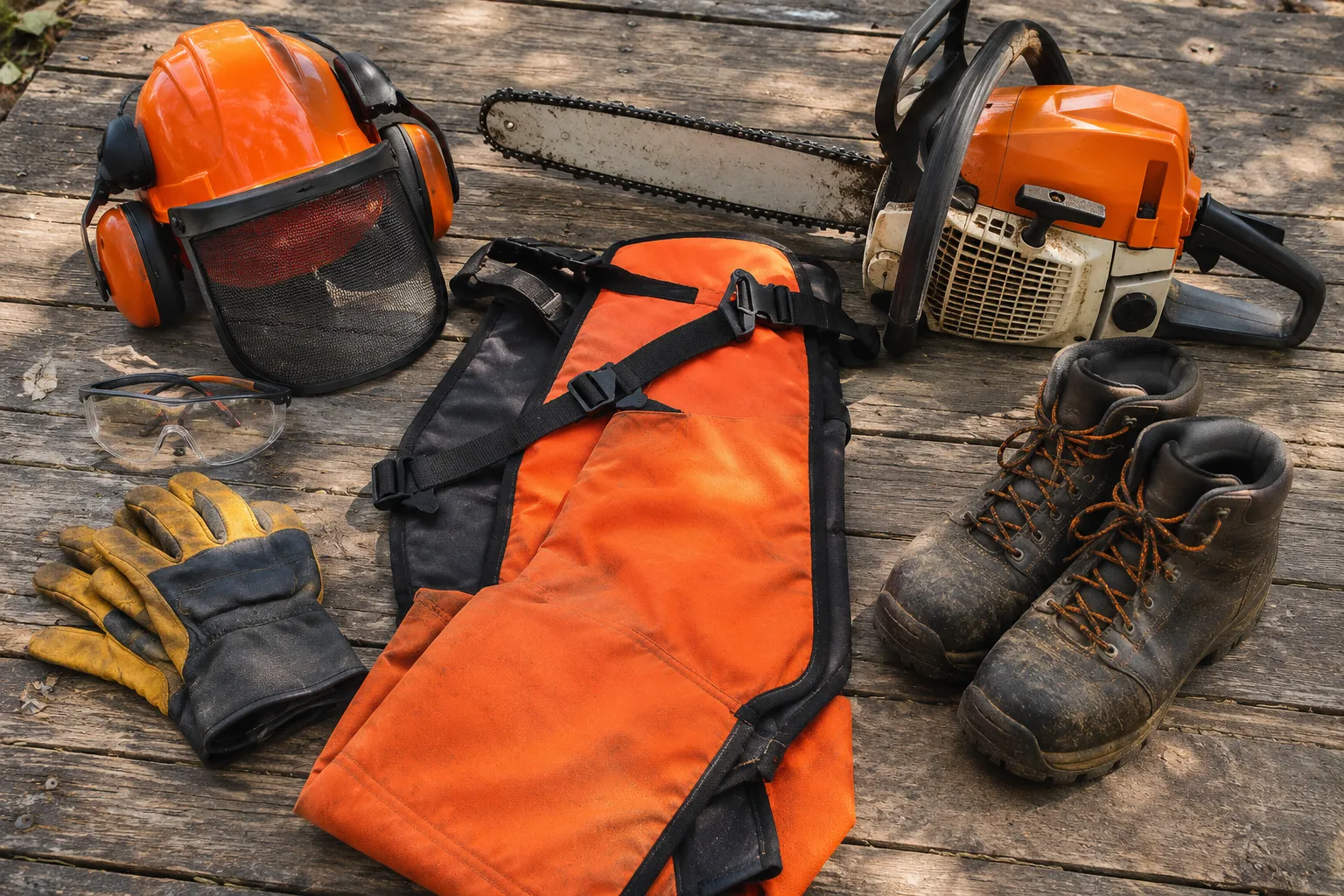
Wear a helmet with a face screen and hearing protection, cut-resistant chaps, chainsaw-rated or sturdy high-top boots, and gloves, every time the saw is running. No single item makes chainsaw work safe. Together they cut the odds that a bad moment becomes a hospital trip.
This guide goes from head to toe. For each item it explains the injury it addresses, the standard to look for, and a rough price. The article is based on safety standards, OSHA’s logging rules, university extension guidance, manufacturer pages and retailer listings. Prices are approximate and were checked in November 2026. Always follow your own saw’s manual, which lists the protective gear its maker requires.
The kit at a glance
| Item | Main injury it addresses | Standard to look for | Approx. price |
|---|---|---|---|
| Helmet | Falling limbs, head strikes | ANSI Z89.1 | $50 to $150 |
| Eye and face protection | Chips, sawdust, twigs | ANSI Z87.1 | $10 to $40 as a mesh visor on its own |
| Hearing protection | Noise-induced hearing loss | NRR on the label | $10 to $50 |
| Gloves | Scrapes, splinters, some chain contact | Saw protection claim from the maker | $20 to $90 |
| Chaps or pants | Chain cuts to the thigh and shin | ASTM F1897 | $50 to $160 |
| Boots | Chain cuts to the foot, ankle injuries, slipping | Cut-resistant rating, ASTM F2413 for protective footwear | $120 to $350 |
Head: helmet
What it addresses. Dead limbs and bark fall without warning, and the head is the part you can least afford to hit. Extension guidance recommends a properly fitted hard hat for small falling limbs and debris, and OSHA requires head protection where there is a risk from falling or flying objects.
What to look for. A helmet marked to ANSI Z89.1. Forestry helmets are usually sold as a system: the helmet, a fold-down mesh visor and ear muffs mounted on one frame. That is the cheapest way to get three items at once, and it is why most buyers start there.
Care. Helmets have a manufacturer date stamp. Replace the helmet on the schedule the maker gives, and replace it after any hard impact even if it looks fine. See our best chainsaw helmet guide for specific systems.
Eyes and face
What it addresses. Chips, sawdust and twigs fly back at the operator. Eye injuries from chainsaw work are common and avoidable.
What to look for. Safety glasses or goggles marked Z87.1, or a mesh visor. OSHA’s logging rule allows logger-type mesh screens for chainsaw work, and says face protection that covers both the eyes and face removes the need for separate eye protection. Mesh keeps airflow and does not fog, but small particles can pass through it, so some cutters add glasses underneath. If you wear a visor, check that it carries a Z87.1 mark.
Ears
What it addresses. Extension guidance notes that chainsaw noise can exceed 90 dB, enough to damage hearing over time. Damage builds up quietly, so there is no warning pain.
What to look for. A noise reduction rating, or NRR, printed on the package. Ag-safety guidance recommends a minimum NRR of 25. Forestry helmet systems commonly list ear muffs in the low-to-mid 20s, and you can add foam plugs under the muffs for more. Wear them for the whole session, not just when the saw is loud.
Hands
What it addresses. Gloves protect against splinters, scrapes and blisters, and they keep your grip when hands are sweaty. Some gloves add cut-resistant fabric.
What to look for. If you want saw protection, buy gloves sold for that purpose, and read where the protection is. Many place it on the back of the left hand and fingers, the side nearest the bar. Treat that as a bonus. A running chain can still cut through a glove. Our best chainsaw gloves guide compares options.
Legs: chaps or pants
What it addresses. A chain that slips or kicks back tends to land on the left thigh. That is the classic chainsaw injury, and deep thigh cuts can bleed severely. OSHA’s logging standard requires chain saw operators to wear leg protection of cut-resistant material that covers the thigh to the top of the boot.
What to look for. A label stating conformance to ASTM F1897, the specification for leg protection for chain saw operators. Many chaps also carry a UL classification mark. Check the label for the leg length and the layer count, and size the length to your height so the chaps reach the top of your boots.
How it works. The protective layers are loose fibers that pull out, wrap the drive sprocket and clog the chain. They do not make a leg cut-proof, and they only protect where they cover.
Apron or wrap. Apron chaps cover the front of the leg and are cooler and faster to put on. Wrap-around styles protect more of the leg and cost more. Cut-resistant pants cost more again but are the most comfortable in warm weather. Our best chainsaw chaps guide covers the choices.
Feet: boots
What it addresses. The feet sit close to the bar when you cut low, and a slipped saw can reach them. Boots also guard against dropped logs and slipping.
What to look for. OSHA’s logging standard calls for supportive, waterproof or water-repellent boots that cover the ankle, with cut-resistant protection for chain saw operators. True chainsaw boots are rated by chain speed, with Class 1 for 20 meters per second and Class 2 for 24. Steel-toe work boots protect against falling logs, but they do not stop a chain, so they are a step below. Outsoles with deep lugs add traction. See best chainsaw boots.
What not to wear
- Loose or frayed clothing. Extension guidance says to wear well-fitting clothes and avoid anything dangling or ragged that can catch on limbs or on the saw.
- Scarves, drawstrings and jewelry. Tuck them in or leave them off.
- Shorts, sandals and sneakers. None of these protect against a chain.
- Dark clothing in open areas. Bright colors make it easier for a helper or a passer-by to see you.
- Headphones. Earbuds do not replace hearing protection, and they hide the sounds of a cracking limb.
Minimum kit on a tight budget
If you cannot buy everything at once, buy in this order. It follows where the worst injuries happen and what is cheapest per risk removed.
- Chaps. Leg cuts are the most common serious chainsaw injury.
- A helmet system with visor and muffs. It covers head, face and ears in one purchase.
- Sturdy, high-top boots. Use the boots you own if they are leather, cover the ankle and have good soles, then upgrade to chainsaw-rated boots later.
- Gloves. Ordinary snug leather gloves are fine until you can afford saw-protection gloves.
Used gear is fine for gloves and boots. Do not buy a used helmet or chaps that have already seen a chain strike or a hard fall, because you cannot see the damage.
First aid and not cutting alone
Gear lowers the risk, and a plan covers what is left.
- Do not cut alone. Keep someone within earshot. If you must work solo, tell a person where you are and when you will be back, and carry a charged phone. Husqvarna’s guidance advises telling a contact your location, carrying a phone or radio and checking in at set intervals.
- Carry a first-aid kit. OSHA requires one at logging work sites. For a homeowner, a kit with pressure bandages and gloves is the minimum.
- Know how to control severe bleeding. Stop the Bleed guidance says to call 911 first, apply firm direct pressure, and for a limb wound that keeps bleeding, apply a tourniquet above the wound, tighten until the bleeding stops, and note the time. Take a class to learn it before you need it.
- Keep the phone on you, not in the truck.
A pressure bandage and a tourniquet are cheap compared with the saw. They only help if you can reach them with one hand.
Bottom line
Start with chaps and a helmet system, add boots and gloves, and never cut alone. Choose items marked to the standards above, and replace anything that has taken a hard hit. Protective gear reduces injury and does not prevent it, so the first piece of safety equipment is still careful technique. Read chainsaw kickback next, and see our chainsaw accessories hub for the rest of the kit.
Common questions
What is the minimum chainsaw safety gear?
A helmet with eye and hearing protection, cut-resistant chaps or pants, sturdy boots (ideally chainsaw-rated) and gloves. Most saw manuals and safety agencies list these items, and OSHA requires them for logging work. A homeowner is not covered by that rule, but the injuries are the same.
Do chainsaw chaps really stop a running chain?
Chaps are made to snag and clog the chain and stop it before it cuts through to the leg. They reduce the chance and the severity of a leg cut. They are not a guarantee, and they do not help if the chain reaches skin they do not cover.
Can I use regular work gloves for chainsaw work?
Plain leather gloves protect against splinters and scrapes, and they keep a good grip. They do not stop a chain. Gloves sold with saw protection add cut-resistant material, often on the back of the left hand, which is the hand closest to the bar.
How do I know if chainsaw chaps meet the standard?
Look for a label stating conformance to ASTM F1897, and for a UL classification mark if the maker uses one. Check the label for the number of ply layers and the stated leg length. Shop-bought chaps with no label are not worth the money.
What should I not wear when running a chainsaw?
Loose or frayed clothing, scarves, dangling cords or drawstrings, shorts, sandals, sneakers, and jewelry. Anything that can catch on a branch or reach the chain is a hazard.