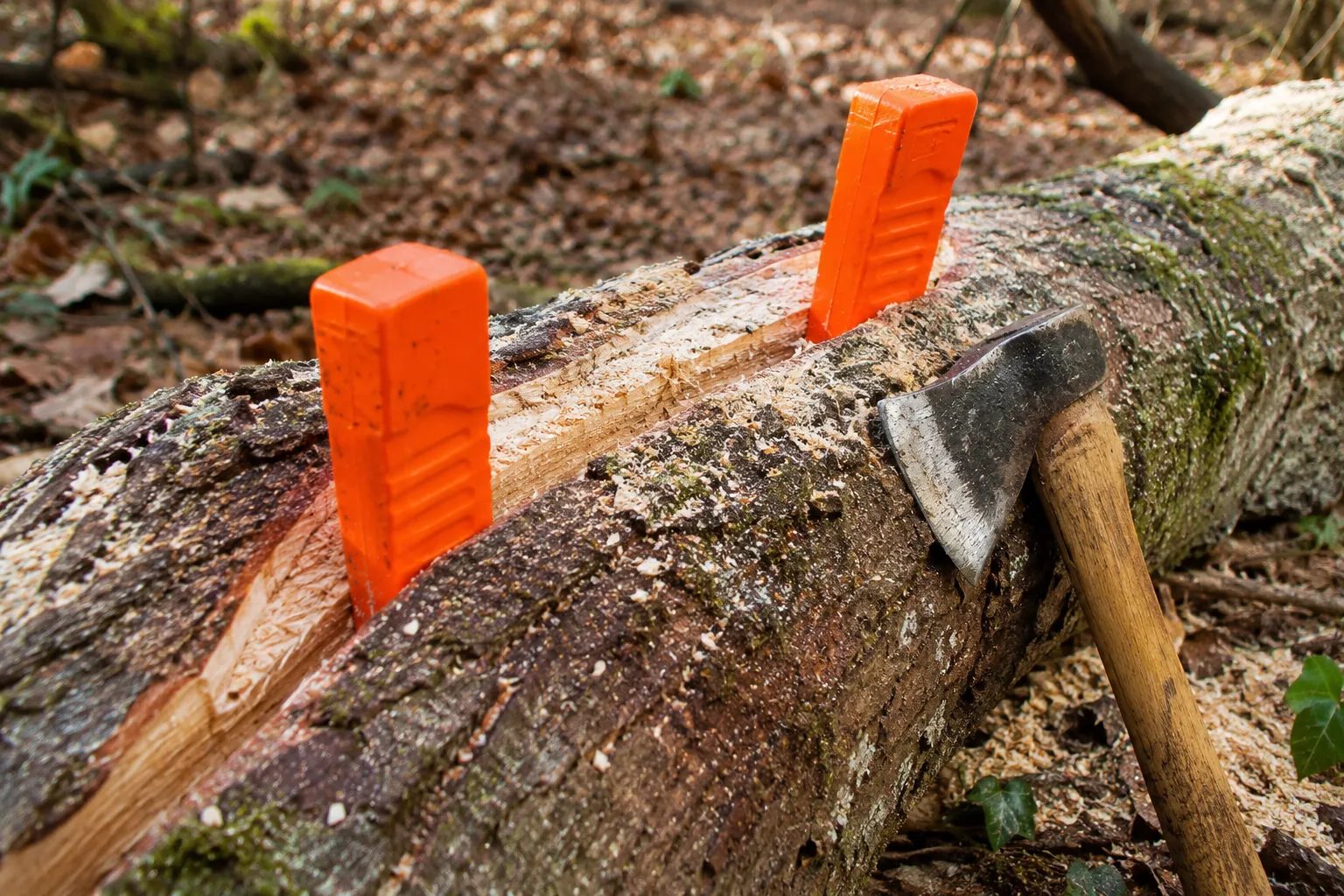
A felling wedge is a tapered block, usually plastic, that you tap into a saw cut to hold it open or push it apart. It looks too simple to matter. It solves two problems that catch most new firewood cutters: a bar that gets pinched in the cut, and a tree that will not fall where you want it.
When you cut a log that is held up at both ends, or a tree that leans back against your cut, the wood closes on the bar. A pinched saw can be hard to free, and the usual fix, shoving or prying on a running saw, is how people get hurt. A wedge tapped into the kerf behind the bar keeps that gap open. In felling, wedges driven into the back cut lift the tree a little and help it fall the way you planned. Our guide to how to buck a log shows where they go in a bucking cut.
This guide compares five plastic wedges that are sold in the US, using manufacturer pages, retailer listings and Clemson Extension forestry guidance. It is not based on hands-on testing. Prices are approximate and were checked in November 2026. Wedges help with some problems, but they do not make felling safe. Read your saw’s manual, and call a professional for trees that are leaning hard, hung up, dead or near buildings. See what to wear when using a chainsaw for protective gear.
Why plastic and never steel
Splitting wedges and steel wedges belong in a log, struck with a sledge. They do not belong near a running chain. Clemson Extension notes that metal wedges can throw fragments toward the operator when hit by a chain or an axe, while a plastic wedge tends to deform instead of shattering. A chain that nicks plastic will still dull, but that is far less damaging than hitting steel.
Plastic can still chip, so wear eye protection. Replace a wedge that is badly mushroomed or deeply cut.
Quick comparison
| Wedge | Size | Approx. price | Surface | Best for |
|---|---|---|---|---|
| Oregon 5.5” felling wedge (23565) | 5.5” | $8 to $9 each | Plastic, lightweight | Bucking and small cuts |
| Husqvarna 8” felling wedge (598 03 59-02) | 8” | $12 to $15 each | ABS plastic | Small to medium trees |
| Stihl 10” plastic wedge | 10” | $15 to $16 each | Plastic | Larger trees, easier lift |
| Redneck Convent 10” spiked wedges | 10” | Check listing | Angled spikes, single taper | Bite on slick or stacked wedges |
| Timber Savage 5.5” set of 4 | 5.5” | $15 to $27 per set | Smooth and barbed sides | Buying several small wedges at once |
1. Oregon 5.5” felling wedge: best for bucking
Oregon lists its 5.5” plastic wedge (part 23565) as a lightweight yellow wedge for felling and bucking. Oregon’s page gives its dimensions as 2 x 3 x 5.5 inches and 3.2 ounces. It is small enough for a pocket, and it is the size most often used to prop a kerf open when bucking logs into rounds. Oregon also lists 8”, 10” and 12” versions.
Good
- Very light and cheap enough to carry spares
- Right size for bucking logs for firewood
- Oregon sells the same line in 8”, 10” and 12” sizes
Not so good
- Too short to lift a larger tree
- Lifts only a small amount, so it takes two to stack for taller cuts
Buy it if your main job is bucking downed trees into firewood lengths and you want a few cheap wedges in the saw bag.
2. Husqvarna 8” felling wedge: best all-around size
Husqvarna’s 8” wedge is made of high-impact ABS plastic, according to retailer listings, and can be used for felling or for bucking a tree already on the ground. Retailers list it at about $12 to $15, and the US part number is 598 03 59-02. Sources disagree on its lift: some US listings show a maximum lift of about 1 inch, while Husqvarna’s EU page gives 32 mm. Plan on roughly an inch.
The 8” size suits the trees most homeowners drop, those that a 16” to 20” bar can cut through. It is also long enough that you can tap it in without your hand near the bar.
Good
- Common size that fits most backyard felling jobs
- Backed by a major saw brand and sold at many dealers
- Works for both felling and bucking
Not so good
- Lift of about an inch limits what it can do with a heavy lean
- Priced above generic wedges
Buy it if you want a single wedge size that covers most small to medium trees.
3. Stihl 10” plastic wedge: best for bigger trees
Stihl sells plastic wedges in several lengths. Stihl’s size list includes 5.5”, 7.5”, 10” and 12”, plus a 10” tri-taper. The 10” version sells for about $15 to $16 at retailers such as Koenig Equipment and Gustharts. A longer wedge has a gentler slope, so it gives more mechanical advantage. That makes it easier to drive into a heavy or leaning tree.
Good
- Longer taper is easier to drive into big wood
- Sold by the saw maker, so dealers usually stock it
- Several lengths to build a matched set
Not so good
- Overkill for small bucking work
- Prices differ by dealer
Buy it if you fell trees with a 20” or longer bar and want a wedge with more reach than an 8”.
4. Redneck Convent 10” spiked wedges: best bite
Redneck Convent sells 10” plastic wedges in a 2-pack, with angled spikes on the face. A Walmart listing counts 11 spikes per wedge and notes that they are single taper and are not meant for splitting firewood. The spikes grip the wood, and Clemson Extension says a barbed or spiked wedge is the better choice when wedges must be stacked because it is less likely to squirt out. The trade-off is that spikes make a wedge harder to drive and to remove.
A variety 3-pack with 5.5”, 8” and 10” sizes is also listed. Current prices could not be confirmed.
Good
- Spikes resist slipping out of the cut
- Single taper design suits felling lift
- Variety pack covers three sizes
Not so good
- Harder to drive and pull than smooth wedges
- Price and availability vary by listing
Buy it if you cut slick or wet wood and your wedges have been working loose.
5. Timber Savage 5.5” set of 4: best value pack
Timber Savage sells its 5.5” wedges as a set of four, with a smooth side and a barbed side. An eBay listing shows a set at $26.99, and a review roundup priced it near $15. Retail listings call the material plastic or ABS, and the exact polymer is not stated.
A four-pack is useful because wedges get lost in sawdust, and because bucking often calls for two at once.
Good
- Four wedges for about the price of two single wedges
- Barbs grip when you need them, smooth side when you do not
- Small enough to keep one in each pocket
Not so good
- Only one size, so it does not replace an 8” or 10”
- Barbed side is harder to drive
Buy it if you want a cheap stock of bucking wedges and expect to lose a few.
How to choose felling wedges
Match the size to the job
Clemson Extension notes that wedges commonly come in 5.5”, 8”, and 10” or 12” lengths, and that most fellers carry three sizes. The 5.5” and 8” are the workhorses for trees under about 20 inches across, and the 5.5” is the one for bucking. Bigger trees call for longer wedges.
Single taper, double taper and textured
USDA Forest Service guidance describes the single taper wedge as the one that lifts in felling, and the double taper as the one used to spread a cut during bucking. Many consumer wedges split the difference. Surfaces come smooth, textured, or spiked. Spikes bite best, smooth drives easiest.
How many to carry
For firewood, two 5.5” wedges and two 8” or 10” wedges is a sensible start. Two lets you place one on each side or stack them when the cut is wide. Clemson suggests a taller heel of 1.5 to 2 inches to avoid stacking at all. Keep them in a pouch or pocket so you do not have to leave the saw to find one.
Do not use them as splitting wedges
Plastic felling wedges are not for splitting. Our splitting axe guide covers the tools that are. For other kit, see chainsaw accessories, and for the saw itself, best chainsaw for cutting trees.
Bottom line
Start with a pair of Oregon 5.5” wedges for bucking and a pair of Husqvarna 8” wedges for felling. Add a Stihl 10” if you cut bigger trees, or Redneck Convent spiked wedges if yours keep slipping. A wedge costs about as much as a sandwich, and it is cheaper than a pinched bar.
Common questions
What is a felling wedge used for?
A felling wedge is driven into the back cut to lift the tree slightly and help steer its fall. In bucking, a wedge goes into the kerf behind the bar to hold the cut open so the saw does not get pinched.
Can I use a steel splitting wedge instead?
No. A running chain that touches a steel wedge can throw fragments and damage the chain. Splitting wedges are made for splitting, not for felling or bucking. Use wedges made of plastic for cuts that happen near the chain.
How many felling wedges should I carry?
Most guidance suggests carrying at least two or three, in different sizes. A common firewood kit is two 5.5-inch wedges for bucking and two 8-inch or 10-inch wedges for small trees. Carry more if you fell larger trees.
What is the difference between a single taper and a double taper wedge?
A single taper wedge has one sloped face and lifts, which is what felling needs. A double taper wedge slopes on both faces and spreads a cut open, which suits bucking. Many wedges sold for homeowners are marketed for both jobs.
Are spiked wedges better?
Spikes or barbs bite into the wood and are less likely to slip, which helps when wedges must be stacked. They are also harder to drive and pull out. Smooth or textured wedges drive more easily on small trees.