A splitting axe is built to do one thing: wedge a log apart along the grain. It is not a felling axe. A felling axe has a thin edge that cuts across fibers, and it sticks in a round instead of splitting it. A splitting axe has a heavy, wide-angled head that pushes the wood apart as it goes in.
That sounds minor, but it decides whether you split a stack in an afternoon or get a sore back and a stuck axe. This guide covers the four tools used for the job, then compares five real products. It relies on manufacturer pages, retailer listings and published buying guides. It is not based on hands-on testing. Prices are approximate and were checked in November 2026.
Splitting axe vs maul vs wedge and sledge
| Tool | Typical head weight | Best for |
|---|---|---|
| Splitting axe | About 3 to 6 lb | Medium rounds and knot-free wood; faster, easier swing |
| Maul | About 6 to 8 lb | Big, dense rounds; relies on weight |
| Steel splitting wedge and sledge | Wedge plus a 6 to 10 lb sledge | Knotty, twisted or stringy rounds that stop an axe |
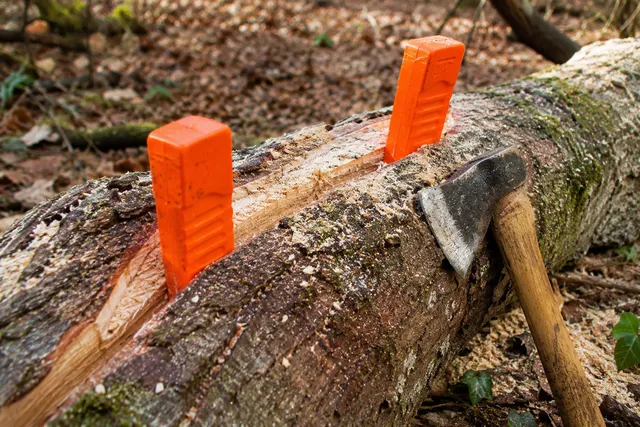
Published guides agree on the general pattern, though the exact numbers vary. A splitting axe is lighter, with a sharper, tapered edge, and works well on small to medium pieces. A maul is heavier, with a blunt, wedge-like head, and splits large, dense rounds by sheer weight. When a round will not split, a steel wedge and sledgehammer drives through it, and the wedge can be hit repeatedly without damaging a handle.
Neither axe nor maul is rated for striking another tool unless the maker says so. Use a sledge on a wedge.
Splitting is hard work, and a swing that glances off a round is dangerous. Wear safety glasses and sturdy boots, keep bystanders back, and split on a stable chopping block. For people with a lot of wood and little patience, see the best log splitter, or the cord of wood calculator to size the job.
Quick comparison
| Tool | Type | Length | Weight | Approx. price |
|---|---|---|---|---|
| Fiskars X27 | Splitting axe | 36” | About 6.3 lb | $45 to $90 |
| Husqvarna S2800 | Splitting axe | 27.5” | 6.17 lb | About $100 |
| Gransfors Bruk Large Splitting Axe | Splitting axe | 70 to 80 cm | 2.3 kg | $209 to $250 |
| Council Tool 6 lb maul | Maul | 36” | 6 lb head | $44 to $77 |
| Estwing 6 lb maul | Maul | 36” | 6 lb head | $56 to $80 |
1. Fiskars X27 Super Splitting Axe: best overall
The X27 is the best-known splitting axe in the US, and it is still sold. Retailers in 2026, including Walmart, Ace Hardware and Home Depot, list it at about 6.3 pounds and 36” long, with a fiberglass shock-absorbing handle. No successor has been announced in the sources checked. Prices run about $45 after a Home Depot discount to about $70 at Walmart, with some sellers higher.
Its long handle and weight at the head give a lot of momentum, so it behaves more like a light maul than a classic axe.
Good
- Long handle and head-heavy balance split big rounds well
- Fiberglass handle will not rot or dry out
- Widely stocked and fairly priced
Not so good
- At 36” it is long for small users or tight spots
- Priced above generic axes when not on sale
Buy it if you want one dependable axe for most of your firewood and do not want to spend over $100.
2. Husqvarna S2800: best composite option
Husqvarna’s S2800 splitting axe, which is sold as the large composite splitting axe, has a fiber-reinforced polyamide shaft with stainless steel protection near the head. Husqvarna’s page lists 27.5” in length, 6.17 pounds total and a 5.07-pound head, at $99.99. The head has a non-stick coating to reduce friction, and a milled back that Husqvarna describes as suited to splitting wedges. The page’s spec table is labeled for the S2800, so check dimensions against the product you buy.
Good
- Shorter handle gives more control than a 36” tool
- Non-stick head coating helps it release from wood
- Handle resists splitting and rot
Not so good
- Shorter handle means less leverage on big rounds
- Costs more than the Fiskars
Buy it if you prefer a shorter, controllable axe and already use Husqvarna gear.
3. Gransfors Bruk Large Splitting Axe: best heirloom
The Swedish maker lists its Large Splitting Axe at 70 to 80 cm long and 2.3 kg, with a hickory handle and a straight or curved option. Gransfors says it is for splitting firewood of all types, and gives a 20-year warranty. US retailers list it at about $209 to $250, such as Lee Valley, Lehman’s and Highland Woodworking. It is a hand-forged tool, not a first axe.
Good
- Hand-forged, with a long warranty
- Maker lists hickory handles in straight or curved shapes
- Gransfors states the axe is made for all types of firewood
Not so good
- Costs several times more than a Fiskars
- Lighter than a maul, so it is less suited to huge rounds
Buy it if you split by hand every winter and want one axe to keep for life.
4. Council Tool 6 lb splitting maul: best traditional maul
Council Tool’s 6-pound sledge-eye maul has a forged steel head on a 36” American hickory handle, made in the USA. Council’s page says the striking face is meant for steel wedges. Note that some retailers sell an axe-eye version, so check the eye style. Prices vary, from about $44 at Officer Store to $59 at Peavey, $71 at Zoro and $76 at Lee Valley for the axe-eye type.
Good
- Heavy head splits big, dense rounds
- Striking face can drive wedges, per Council
- Hickory handle can be replaced
Not so good
- Wood handle needs care and dry storage
- Tiring for long sessions
Buy it if you split big oak, maple or elm rounds and want a maul that can also drive wedges.
5. Estwing 6 lb splitting maul: best value maul
Estwing sells a 6-pound maul with a 36” handle in hickory (EML-636W, about $80 at Tractor Supply) and in fiberglass (EML-636F, about $56 at Walmart). The fiberglass one costs less and suits wet storage. The hickory handle is the traditional pick.
Good
- Choice of hickory or fiberglass
- Fiberglass model is inexpensive
- Widely stocked
Not so good
- Fewer maker specs available in the sources checked
- Confirm the handle type before ordering
Buy it if you want a straightforward 6 lb maul at a sensible price.
How to choose a splitting axe
Head weight
Heavier heads do more of the work, but tire you faster and are harder to aim. A 4 to 6 pound head suits many adults. Go heavier only for large, dense wood and only if you are strong enough to swing it with control.
Handle length
Longer handles add leverage and head speed, which helps on big rounds. Shorter handles give control on small logs and in tight spaces. A 36” handle is the norm for full-size tools, and 27 to 30” suits kindling and smaller users.
Handle material
Hickory is traditional and replaceable. Fiberglass and composite handles resist rot and shocks. Check that the handle is solidly seated before every session.
Wood matters too
Dry, straight-grained wood splits far easier than green or knotty wood. If you are not sure how dry yours is, a firewood moisture meter tells you. The firewood BTU chart shows which species are worth the effort. And if you are cutting rounds to size, the best chainsaw for firewood guide covers the saw side.
Bottom line
For most people the Fiskars X27 is the best splitting axe: it is long, head-heavy, affordable and still sold. Pick the Husqvarna S2800 if you want a shorter handle, the Gransfors Bruk Large Splitting Axe if you want an heirloom, or a Council Tool 6 lb maul for dense wood and wedges. If the pile is big enough, a log splitter is the better answer.
Common questions
What is the difference between a splitting axe and a maul?
A maul has a heavier, blunter head, often 6 to 8 pounds, and a longer handle. It forces wood apart with weight. A splitting axe is lighter, typically 3 to 6 pounds, with a sharper, more tapered edge. Sources differ on exact ranges, so check each tool's listed weight.
What weight splitting axe should I buy?
For most adults, a head of about 4 to 6 pounds on a 28 to 36 inch handle is a good range. Heavier heads do more of the work but tire you faster. If you are unsure, start lighter and use a wedge on tough rounds.
Can I hit a splitting wedge with a splitting axe?
Only if the maker says the tool is designed for it. Many axes are not. A maul with a striking face or a sledgehammer is built to drive wedges. Never strike an axe poll with a steel hammer unless the manufacturer allows it.
What handle length is best?
Longer handles generate more head speed and are better for big rounds, while shorter handles give control on small logs. A 36 inch handle is common for full-size splitting axes and mauls. Shorter axes in the 27 to 30 inch range suit smaller users or kindling.
Is a log splitter better than an axe?
A log splitter is faster and easier on the body, especially for large or knotty rounds. An axe is cheaper, quieter and needs no fuel. Many people keep an axe for small pieces and use a splitter for the rest.