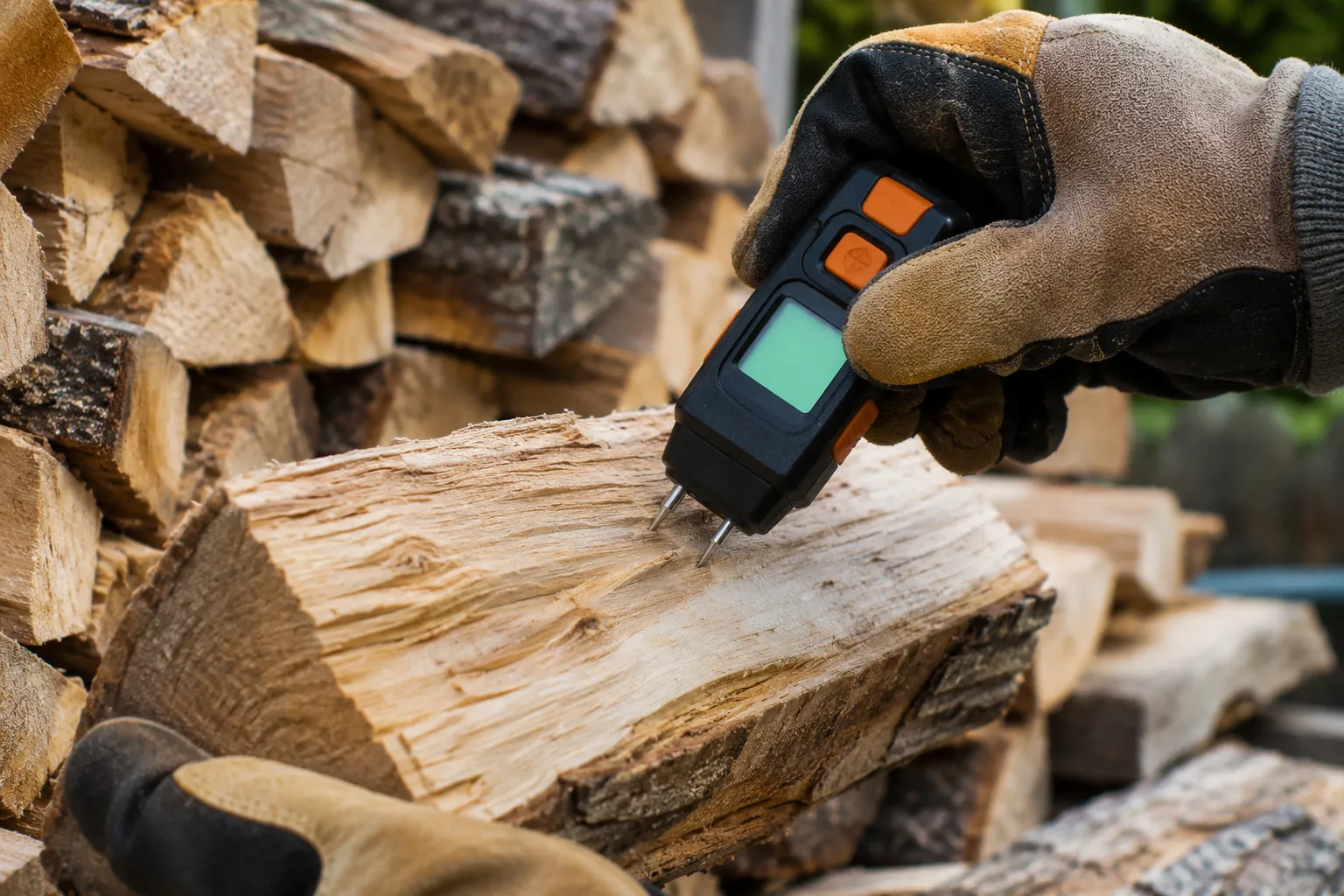
Wet firewood is the most common reason a wood stove smokes, a fire sputters and a chimney builds up creosote. The trouble is that you cannot see how wet a piece is. Bark, color and weight give clues, but a moisture meter gives you a number in seconds.
A good one costs less than a tank of gas and a chain, and it settles the question “is this ready to burn?” Hold it up against the EPA’s guidance: its Burn Wise pages say wood burns best below 20 percent moisture content. That program ran from 2009 to 2025 and EPA says its content is no longer being updated, but the pages remain online and the advice has not changed.
This guide covers how to use a meter correctly, then five models at different price points. It is based on manufacturer pages and specs, retailer listings and the EPA’s published guidance. Prices are approximate and were checked in November 2026.
Quick comparison
| Meter | Type | Approx. price | Listed range | Best for |
|---|---|---|---|---|
| Dr.meter MD812 | Pin | About $15 to $30 | 5 to 40% | Cheapest way to check a stack |
| General Tools MMD4E | Pin | $52 to $63 | 5 to 50% (WME) | Better build, backlit display |
| Klein Tools ET140 | Pinless | About $50 | Relative scale, hardwood and softwood modes | Fast scanning without holes |
| Wagner Orion 910 | Pinless | About $430 | 4 to 32% | Precision, many species |
| Delmhorst J-2000 | Pin | About $450 | 6 to 40% | Species and temperature correction |
How to measure firewood moisture
- Split a piece. The outside of a log dries first and can read dry while the core is wet. EPA’s flyers say to split the wood and test the newly split side.
- Measure the fresh face. Press the pins into the split face, following the meter’s instructions about pin direction. Many call for pins aligned with the grain. Avoid knots and resin pockets.
- Take several readings. Moisture varies from one piece to the next. A study from the Irish forestry research body COFORD advises testing at least five pieces.
- Compare to the target. Below 20 percent is ready. Above that, keep seasoning: stacked off the ground, top covered, sides open (see our firewood rack guide).
- Set the species. Many meters have a species or wood-type setting. Use it, or apply the correction chart supplied with the meter.
1. Dr.meter MD812: cheapest pin meter
The MD812 is a two-pin meter with a listed 5 to 40 percent range, 1 percent resolution and a stated accuracy of 1 percent on spec sheets, powered by a 9V battery. A review site lists it at about $15 to $20, and prices vary by marketplace. Availability is patchy: the US Amazon listing was showing as unavailable when checked, so confirm stock before relying on it. It has no auto shutoff, so remove the battery or switch it off.
Good
- Very low price
- Includes spare pins and a battery, per one review
- Plenty for deciding whether a stack is dry
Not so good
- No auto shutoff
- Spec sheets come from the maker and may not match the branded unit
- Stock and pricing are inconsistent
Buy it if you want a rough, cheap check for a few cords of wood.
2. General Tools MMD4E: best step-up pin meter
The MMD4E is a pin-type meter with 0.3-inch pins and a backlit LCD. Listings give a 5 to 50 percent range on wood (in wood moisture equivalent), 0.1 percent resolution and plus or minus 3 percent accuracy, with a selector for wood or building materials, a hold button, auto power-off and replaceable pins. Retailers list it at roughly $52 to $63, and Zoro lists it as discontinued, so check availability.
Good
- Backlit screen and hold button
- Auto power-off and replaceable pins
- Wide measuring range
Not so good
- Costs two to three times the budget pin meters
- Stated accuracy is plus or minus 3 percent
- Short pins read the surface layer only
Buy it if you want a sturdier brand-name pin meter that you will use for many seasons.
3. Klein Tools ET140: best pinless option
The Klein ET140 is a pinless meter that senses moisture electromagnetically to a depth of about 3/4 inch. It has modes for drywall, masonry, hardwood and softwood, and sells for about $50 at major retailers. It reports relative moisture, so it is better at comparing pieces than giving a lab-grade percentage. Because it works by contact with a flat surface, rough split faces are harder to read than a plank. Wagner’s manual notes that a pinless meter underestimates moisture in material thinner than its sensing depth, which matters for slim splits.
Good
- No pin holes, quick to scan a pile
- Hardwood and softwood modes
- Rated to survive a drop of about 6.6 feet
Not so good
- Relative readings, not a precise percentage
- Rough surfaces and thin splits can throw it off
Buy it if you prefer pinless and mainly want to compare pieces quickly.
4. Wagner Orion 910: most precise pinless meter
Wagner’s Orion 910 reads about 3/4 inch deep, with a standard range of 4 to 32 percent moisture content and a species-settings booklet, and the kit includes a protective boot and carrying case. Wagner lists it at about $430 and covers it under its 7-year warranty. Buy from an authorized dealer, because a guide linked from Wagner’s site warns that counterfeit pinless meters carrying its name have turned up on third-party marketplace listings.
Good
- Species settings and a precision build
- Long warranty and a hard case
Not so good
- Many times the price of a hobby meter
- Range tops out at 32 percent
- Overkill for most firewood piles
Buy it if you already do woodworking or flooring and want one precise meter for everything.
5. Delmhorst J-2000: species and temperature correction
Delmhorst is a long-established maker of professional wood meters. The J-2000 is a pin meter that, according to its spec listing, corrects for 50 individual wood species and for temperature, across a 6 to 40 percent range on wood. Delmhorst lists the meter with a case at about $450. Some package variants show as discontinued at resellers, so confirm what is current.
Good
- Built-in correction for many species and for temperature
- Professional pin meter from an established wood-moisture brand
Not so good
- Costs about as much as the Wagner
- Designed for shops and mills more than firewood
Buy it if you want a professional pin meter with species correction and you also work with lumber.
How to choose
Pin or pinless
For firewood a pin meter is the straightforward tool: split a piece, push the pins into the face and read it. Pinless meters are faster and leave no marks, but they are built for flat boards and respond to density, so rough splits give less consistent readings. Bob Vila’s roundup of wood moisture meters chose a pin model, the Lignomat Mini-Ligno E/D, as its top overall pick, with a 6 to 45 percent scale and two pin lengths.
Accuracy limits
Listed accuracy ranges from about 1 to 3 percentage points. That is enough to tell 15 percent from 30 percent wood. Meters read least reliably in very wet wood, and different species read a little differently, which is why species settings matter. Treat the number as a good estimate, and use the same meter and method each time so readings compare.
Skip the premium unless you need it
For a homeowner burning a few cords a year, a pin meter under $60 does the job. Spend more only if you will also use the meter for lumber or flooring.
Use the number
A reading tells you whether to burn or wait, but it also tells you how much heat you are getting. Dry wood delivers more usable heat, and species matters as well: see the firewood BTU chart. To plan how much to cut and stack, use the cord of wood calculator. If you are still choosing a saw to cut it, see best chainsaw for firewood.
Bottom line
A pin meter is the right tool for most firewood burners. The Dr.meter MD812 is the cheap entry, the General Tools MMD4E the sturdier step up, and the Klein ET140 the pick if you want a pinless scanner. Test a freshly split piece, take five readings, and burn when the wood reads under 20 percent.
Common questions
What moisture level should firewood be?
The EPA says wood burns best at a moisture content below 20 percent. Wetter wood burns cooler, makes more smoke and builds more creosote in the chimney.
Where on the log should I measure firewood moisture?
Split a piece and test the freshly exposed inner face. The outside of a log dries first and reads drier than the core, so a reading from bark or an old end can badly understate the real moisture.
Should I buy a pin or a pinless meter for firewood?
A pin meter is the simpler choice for firewood because you push the pins into a split face and read the result. Pinless meters are quicker and leave no holes, but most are designed for flat lumber and are sensitive to wood density and surface contact, so rough, uneven splits are harder to read.
How accurate are cheap moisture meters?
Listed accuracy is often within a few percentage points, which is enough to tell 15 percent wood from 30 percent wood. They are less reliable at high moisture levels, and they read differently by species, so use them to compare pieces and check against the 20 percent target, not as a lab instrument.
How long does firewood take to season?
An older EPA flyer gives roughly 6 months for softwoods and 12 months for hardwoods when split and stored properly. Those are rules of thumb, so measure instead of counting months.