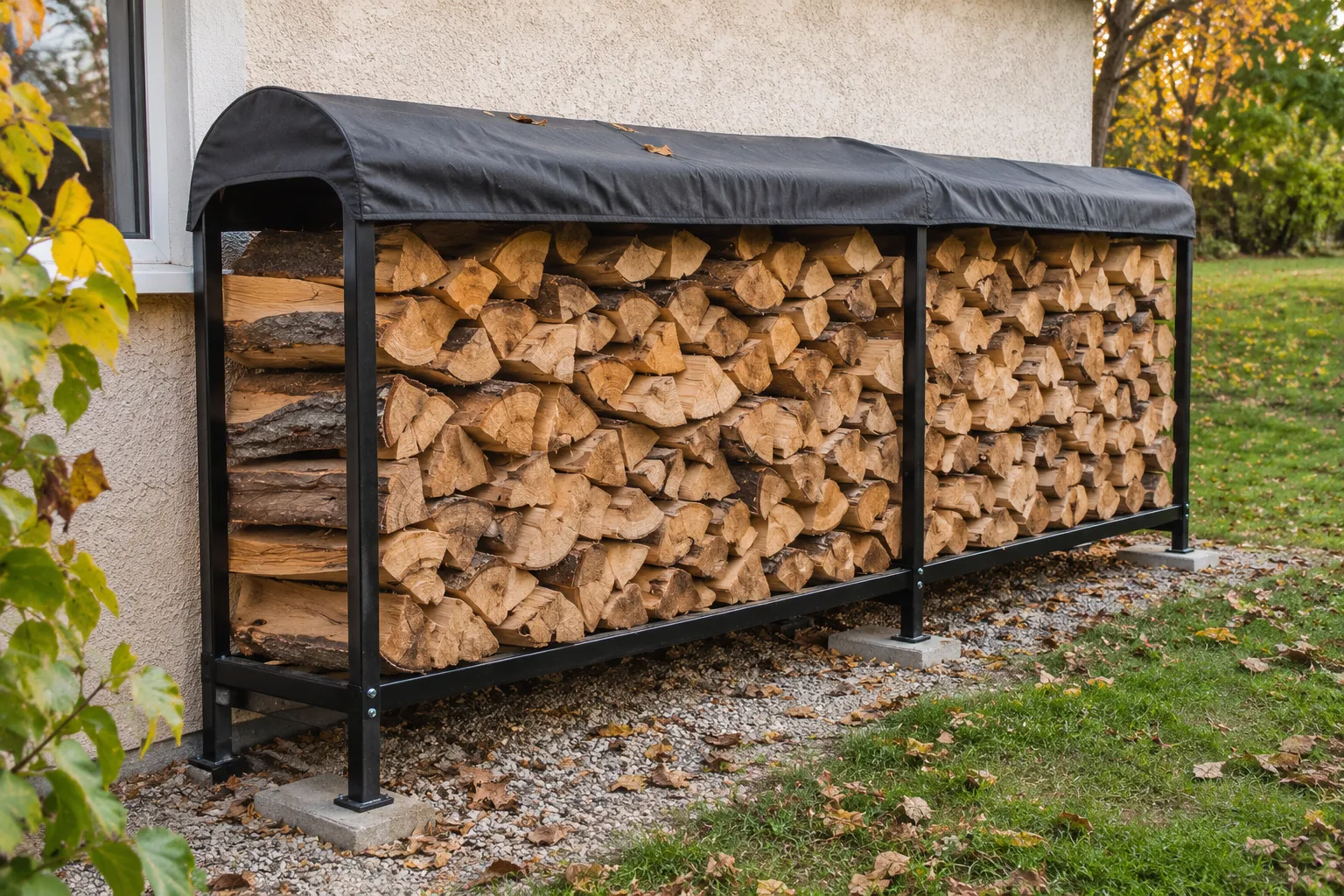
Firewood that sits on the ground soaks up moisture from the soil and rots from the bottom. Wood under a tarp wrapped to the ground never dries. A rack fixes both: it lifts the stack off the ground, keeps it neat and gives air a path through it.
The goal is simple. Keep the wood off the ground, cover the top and leave the sides open. The EPA’s Burn Wise guidance (a program the agency retired in 2025, though its pages remain online) says exactly that, and warns that covering the sides traps in moisture.
This guide compares five racks and rack-building kits, from 4-foot steel tubes to a bracket kit you fit with your own 2x4s. It is based on manufacturer pages and retailer listings. Prices are approximate and were checked in November 2026.
Quick comparison
| Rack | Type | Approx. price | Listed capacity | Best for |
|---|---|---|---|---|
| Pleasant Hearth 4 ft log rack with cover | Steel tube, 4 ft | About $55 | 1/4 cord listed | Lowest price, small supply |
| ShelterLogic Heavy Duty 4 ft (90401) | Steel tube, 4 ft | $80 to $100 | 1/4 cord listed | Sturdy small rack with cover |
| Woodhaven 8 ft rack | Steel tube, 8 ft | $206 to $279 | 1/2 cord listed | Larger supply, best build |
| Mofeez bracket kit | Brackets for 2x4s | $34 to $40 | Depends on your lumber | Custom length, low cost |
| Panacea 40 in hoop rack | Indoor hoop | $52 to $60 | Small | Next to the stove |
How much wood does a rack hold?
A cord is a stack 4 feet high, 4 feet wide and 8 feet long: 128 cubic feet. Most racks hold wood one piece deep, so the width of the stack is the length of your pieces. That gives a simple rule: rack length times rack height times piece length, divided by 128.
| Rack size (length by height) | 16 inch pieces | 24 inch pieces |
|---|---|---|
| 4 ft by 4 ft | 1/6 cord | 1/4 cord |
| 8 ft by 4 ft | 1/3 cord | 1/2 cord |
So a rack 4 feet high and 8 feet long holds one third of a cord with 16 inch pieces and half a cord with 24 inch pieces. Manufacturers often quote the larger number, which assumes longer splits than many stoves take. Check the rack’s depth too: a rack that is 14 inches deep cannot hold 24 inch pieces in a neat row. To plan your supply, use the cord of wood calculator.
1. Pleasant Hearth 4 ft rack with cover: best budget rack
This 4-foot steel log rack is sold with a cover at Tractor Supply for about $55 and is listed as holding up to a quarter cord. It is the cheapest complete rack here. Expect lighter tubing than the premium racks, so do not overload it.
Good
- Lowest price for a rack with a cover
- Compact, good beside a shed or fence
Not so good
- Light construction
- The 1/4 cord listing assumes longer pieces than a shallow rack fits
Buy it if you burn a small amount of wood and want a rack and cover for the least money.
2. ShelterLogic Heavy Duty 4 ft (90401): best small covered rack
ShelterLogic’s 4 ft Heavy Duty rack has a steel frame with a black powder-coat finish and a 2-way adjustable polyester cover. It is listed at about 4 feet wide, 4 feet tall and 1 foot deep, with a stated capacity of up to a quarter cord. Retailers list it at roughly $80 to $100. Ultra Duty versions cost more, but capacity listings for those conflict.
Good
- Adjustable cover that can be set to leave the sides open
- Powder-coated steel frame
- Sold at many national retailers
Not so good
- One foot deep, so it suits short splits
- Costs about $25 to $45 more than the cheapest rack
Buy it if you want a sturdier 4-foot rack and a cover that comes with it.
3. Woodhaven 8 ft rack: best large rack
The Woodhaven 8 ft rack is a 96 by 14 by 48 inch frame of 1-1/2 inch square steel tubing with a baked-on powder coat and stainless hardware, sold with a canvas cover. Prices run from about $206 at eFireplaceStore to $279 at Plow and Hearth. Listings call it a half-cord rack, but at 14 inches deep it holds roughly 14 inch pieces, which works out to a little under a third of a cord. The heavy tubing is the reason to pay more than for lighter racks.
Good
- Heavy-gauge square tube and powder coat
- Eight feet of stack length
- Includes a cover
Not so good
- Most expensive rack in this list
- The half-cord claim only holds for longer pieces than its depth fits
Buy it if you stack a lot of wood and want a rack that you will not replace.
4. Mofeez bracket kit: best for custom length
A bracket kit gives you the corner hardware and you supply the 2x4s. The Mofeez outdoor kit is sold as an adjustable set of brackets with wood screws, and the lumber is not included. Retailers list it at about $34 to $40. You choose the length and the height, so you can fit the rack to a wall or a garage side. ShelterLogic sells a similar bracket kit.
Since you pick the lumber, pick treated 2x4s if the rack will sit outside. Size the rack by the rule above.
Good
- Fits any length you want
- Cheaper than a steel rack of the same size
- Easy to replace a rotted board
Not so good
- Lumber is a separate cost
- You need basic tools and a bit of time
- No cover included
Buy it if you want a custom size and are happy to add your own lumber.
5. Panacea 40 in hoop rack: best for indoors
Panacea’s 40-inch tubular steel hoop rack is the common indoor and covered-porch choice. Retailers list it at about $52 to $60, with a depth near 16 inches. It holds a small stack, enough for convenience beside the stove rather than a season of wood.
Good
- Looks fine in a living room
- Open hoop frame keeps wood off the floor
Not so good
- Holds only a small amount
- No cover, not meant as a main store
Buy it if you want a tidy place for a day or two of dry wood next to the stove.
How to choose a firewood rack
Off the ground, top covered, sides open
This is the rule that matters. Raise the stack on the rack or on rails, cover only the top, and leave a gap between the cover and the wood, as EPA flyers advise. The rack’s tubing does the lifting, but you still have to keep the cover from wrapping down the sides.
Pick the size by the wood you burn
Work out how much wood you burn in a winter, then size the rack to hold a month or two near the house and keep the rest stacked elsewhere. A rack that holds one third of a cord stays tidy and quick to refill. Match the depth to your piece length.
Steel or wood
Powder-coated steel needs no upkeep but costs more. A 2x4 rack built with brackets is cheaper and custom, but the boards rot in time. Both work as long as air flows through the stack.
Check the dryness before you burn
Racks help wood dry, but they do not guarantee it. Test a freshly split piece with a moisture meter before burning. Splitting by hand? See our splitting axe guide, or look at a log splitter for larger volumes.
Bottom line
For most homes, a 4-foot steel rack with a cover such as the ShelterLogic 90401 is plenty for the wood you burn week to week. Buy the Woodhaven 8 ft if you stack more and want a rack that lasts, or a bracket kit if you want a custom length for less money. Whatever you choose, keep the wood off the ground, the top covered and the sides open.
Common questions
How should firewood be stored outdoors?
Off the ground, with only the top covered and the sides open. The EPA's Burn Wise guidance says to store wood outdoors, raised above the soil, and warns that covering the sides traps in moisture. Leave a gap between the cover and the wood so air can move.
How much wood does a firewood rack hold?
It depends on the size and on how long your pieces are. A rack 4 feet high and 8 feet long filled with 16 inch pieces holds one third of a cord. With 24 inch pieces the same rack holds half a cord. A full cord is a stack 4 feet high, 4 feet wide and 8 feet long, or 128 cubic feet.
Should I cover firewood with a tarp?
Cover the top only. A tarp wrapped down the sides traps moisture and slows drying. A cover that stops at the top of the stack keeps rain and snow off while the sides breathe.
How far off the ground should a firewood rack be?
Enough to keep the bottom row out of soil and standing water. The EPA suggests stacking on rails. Even a few inches helps, and a gravel or paved base under the rack keeps the ground from staying wet.
Can I keep firewood on an indoor rack?
A small indoor rack is handy for a day or two of wood near the stove, but keep your main supply outdoors where it can dry. Check your stove's manual and local fire code for clearances.