A replacement chain has to match your saw on three numbers: pitch, gauge and drive link count. Bar length on its own is not enough, because two 18” bars can take different chains. Here is how to find each number.
Start with the bar stamp
Most guide bars are stamped near the mounting end, the part hidden under the side cover, with all three numbers. A typical stamp reads something like 3/8 LP .050 56, meaning 3/8” low profile pitch, .050” gauge and 56 drive links.
If the stamp is legible, you are done. Buy a chain with those three numbers. If it is worn off, measure the old chain as follows.
1. Pitch
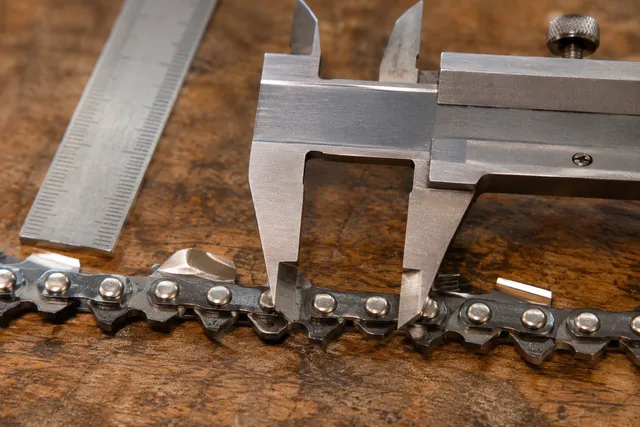
Pitch is the spacing of the links. Measure from the center of one rivet to the center of the rivet two places along, so that you span three rivets, and divide by two.
| Across three rivets | Pitch |
|---|---|
| 1/2” | 1/4” |
| About 0.65” | .325” |
| 3/4” | 3/8” or 3/8” low profile |
| About 0.81” | .404” |
Standard 3/8” and 3/8” low profile measure the same but are different chains. Low profile chain has noticeably shorter cutters and is used on small saws. Our chain pitch guide covers the difference.
2. Gauge
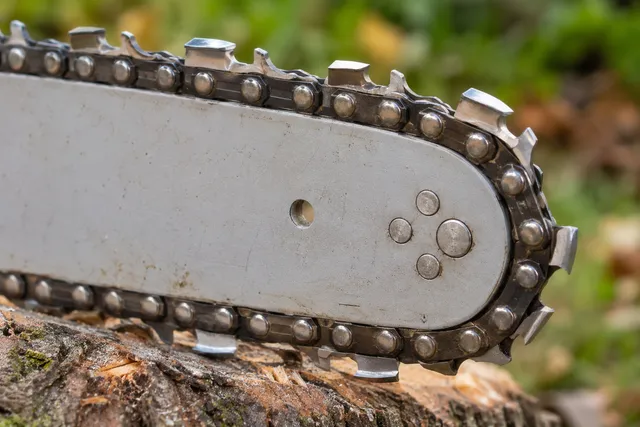
Gauge is the thickness of the drive links, the tabs on the inside of the chain that ride in the bar groove. It has to match the width of the groove.
The common gauges are:
| Gauge | Metric |
|---|---|
| .043” | 1.1 mm |
| .050” | 1.3 mm |
| .058” | 1.5 mm |
| .063” | 1.6 mm |
With a caliper: clean a drive link and measure its thickness directly. This is the reliable method, because the sizes are only a few thousandths of an inch apart.
Without a caliper: a well-known workshop trick is to clean the bar groove and see which US coin fits it snugly without forcing: a dime for .050”, a penny for .058” and a quarter for .063”. Treat that as a rough check only, since coins wear and bar grooves widen with use.
Measure a drive link, not the groove, if the bar is old. A worn groove reads wider than the chain it was made for.
3. Drive link count
Chain length is expressed as a number of drive links.
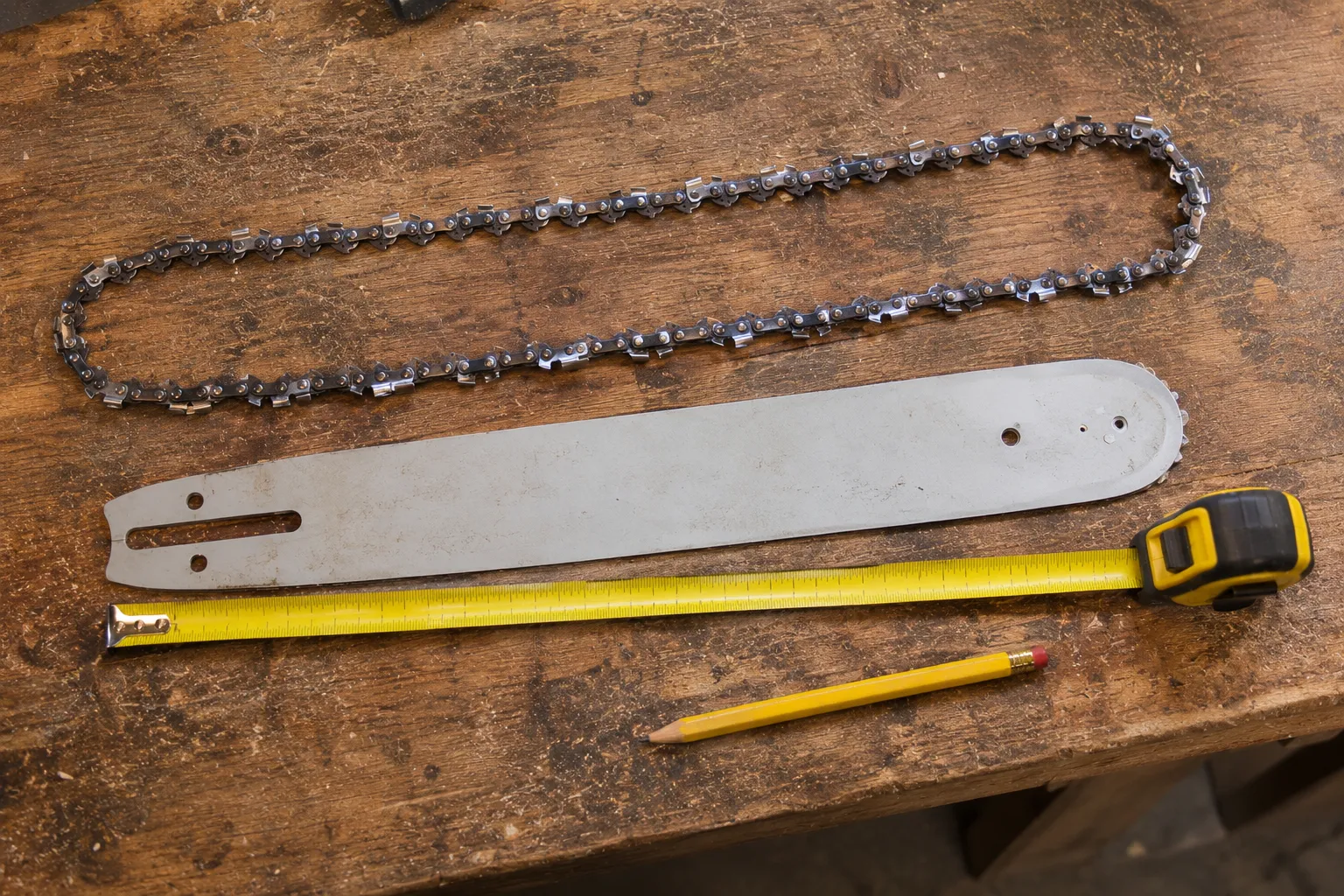
- Take the chain off the saw and lay it out in a loop.
- Mark one drive link with a paint pen or a twist of tape.
- Count every drive link around the loop until you are back at the mark.
Count twice. Being off by one or two links is easy, and a chain that is two links wrong will not tension properly.
Do not count the cutters. The number of cutters depends on the chain’s sequence and tells you nothing about its length.
How bar length is measured
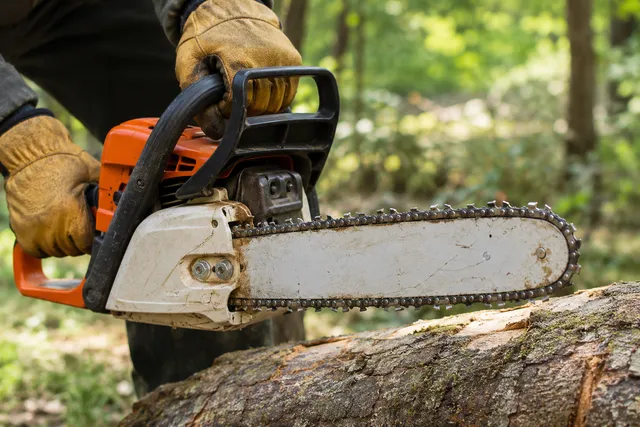
Bar length, the number in a saw’s description, is the cutting length: from the front of the saw body, where the bar comes out, to the tip of the bar, rounded to the nearest even inch.
It is not the full length of the bar, which is a few inches longer because part of it sits inside the saw. A bar that measures 19” from the body to the tip is sold as a 20” bar.
Bar length helps narrow the search, but always confirm with the drive link count. The same nominal bar length can need different counts on different saws.
Putting the numbers together
When you shop, the chain will be described with all three numbers, often alongside the bar length it usually fits. For example:
| Example chain description | Pitch | Gauge | Drive links |
|---|---|---|---|
| 16” low profile chain | 3/8” LP | .050” | 56 |
| 18” chain | .325” | .050” | 72 |
| 20” chain | 3/8” | .050” | 72 |
These are common combinations, not rules. Use your own saw’s numbers.
Other things printed on the box
- Cutter type: full chisel cuts fastest in clean wood, semi-chisel stays sharp longer in dirty wood.
- Low kickback: chains with extra guard links between the cutters, usually marked as low-kickback on the box and a sensible choice for occasional users.
- Sequence: standard, semi-skip or full skip. Standard is right for nearly all homeowner saws.
Once you have the right chain
Fitting it takes a few minutes: see how to put a chain on a chainsaw. The pitch also tells you which file to use when it needs sharpening, which our guide to the best chainsaw sharpeners covers.
Bottom line
Read the three numbers off the bar if you can. If not, measure the pitch across three rivets, measure the thickness of a drive link for the gauge, and count the drive links twice. Buy by those three numbers, not by bar length.
Common questions
How do I know what size chain my chainsaw takes?
Read the stamp on the guide bar near the mounting end, which usually lists pitch, gauge and drive link count. If it is worn away, measure the pitch and gauge and count the drive links on the old chain.
How do I measure the length of a chainsaw chain?
Chain length is given as a number of drive links, not in inches. Count every tab on the inside of the loop that rides in the bar groove.
Are chainsaw chains universal?
No. A chain has to match the saw on pitch, gauge and drive link count. Two saws with the same bar length often take different chains.
How is chainsaw bar length measured?
Measure from the front of the saw body, where the bar emerges, to the tip of the bar, and round to the nearest even inch. That cutting length is the bar size used in catalogs.
Can I use a 3/8 chain on a .325 bar?
No. The pitch of the chain has to match the drive sprocket and the sprocket in the bar nose. Changing pitch means changing those parts as well.