Most saws that will not start have a fuel, air or spark problem, and the fix is usually cheap. The list below runs from most to least likely, so you stop as soon as it runs. A saw that fires and then quits is a different checklist from one that never fires, and the symptom table below tells you which to follow.
This guide draws on Stihl, Husqvarna and Echo support pages and manuals, plus common forum experience. Your saw’s manual is the final word on procedures and specs.
Safety first
Work outdoors, away from the spot where you fueled up. Engage the chain brake, keep the bar pointed away from you and never start the saw with the chain touching anything. Pull the spark plug boot before any hands-on work. If you get fuel on the saw or the ground, wipe it up before you pull the cord.
Symptom table
| What happens | Likely cause | Go to |
|---|---|---|
| Never fires, old fuel | Stale or wrong fuel | Step 1 |
| Fires, then quits at once, or smells of fuel | Flooded | Step 2 |
| Fires on choke only, dies when choke is off | Choke procedure or lean | Steps 3 and 7 |
| Cord pulls, no fire, plug dry | No fuel reaching the cylinder | Steps 1, 6 and 8 |
| Plug wet and black | Flooded or rich | Steps 2, 4 and 5 |
| Starts, runs, dies at throttle | Fuel filter, vent, carburetor | Steps 6 and 8 |
| Pull cord stiff or locked | Chain brake, hydrolock, seizure | Step 2 and dealer signs |
| Cord pulls with no resistance | Mechanical failure | Dealer signs |
Step 1: Stale or wrong fuel
Fuel is the first thing to check, and forum threads say so more than any other cause. Gasoline and mix go bad in weeks, and ethanol can damage rubber lines and the primer bulb.
- Stihl’s storage page says standard pump gasoline should not be kept more than 30 days.
- Husqvarna says old fuel can clog the fuel system and that damage from stale fuel is not covered by warranty.
- Echo’s manuals say not to mix more than you will use in 30 days, or 90 days with stabilizer.
Drain the tank into an approved container. Mix fresh fuel in the correct ratio for your saw. The fuel mix calculator removes the guesswork, and the two-stroke oil guide covers the oil. Do not use straight gasoline or the wrong ratio. Then try again.
Step 2: Flooding
Flooding means too much fuel in the cylinder. It happens from over-priming, pulling too long on full choke, or restarting a warm engine on choke. Signs are a fuel smell and a wet plug.
Maker advice differs a little:
- Husqvarna: put the saw on the ground, hold the throttle wide open and pull the starter repeatedly until it fires. Expect coughing and sputtering as the extra fuel burns off.
- Other guides and forum posts: let the saw sit for a while, remove the spark plug, dry it, pull the cord several times with the plug out to clear the cylinder, and refit it. A wet plug is a common sign.
Which to try? Start with your manual, and if it does not cover flooding, try Husqvarna’s way. If the plug is wet, dry it either way. With the plug out, fuel can spit from the hole, so do this outdoors, point the hole away from you and keep the plug boot away from it.
If the cord will not pull, do not force it. That can be the brake, hydrolock from liquid in the cylinder, or a seizure. Release the brake first, then remove the plug and try again.
Step 3: Choke and starting procedure
Wrong choke use is a common cause of no-starts. Cold start, warm start and flooded start all differ, and the procedure varies by brand and model. Stihl’s M-Tronic saws, for example, work differently from older choke-lever saws. Follow the steps for your saw in how to start a chainsaw.
Common mistakes:
- Pulling the cord many times on full choke, which floods the engine.
- Skipping the half-choke step after the engine first pops.
- Leaving the chain brake on. Many saws will not start easily with it engaged.
- Forgetting the stop switch.
Step 4: Spark
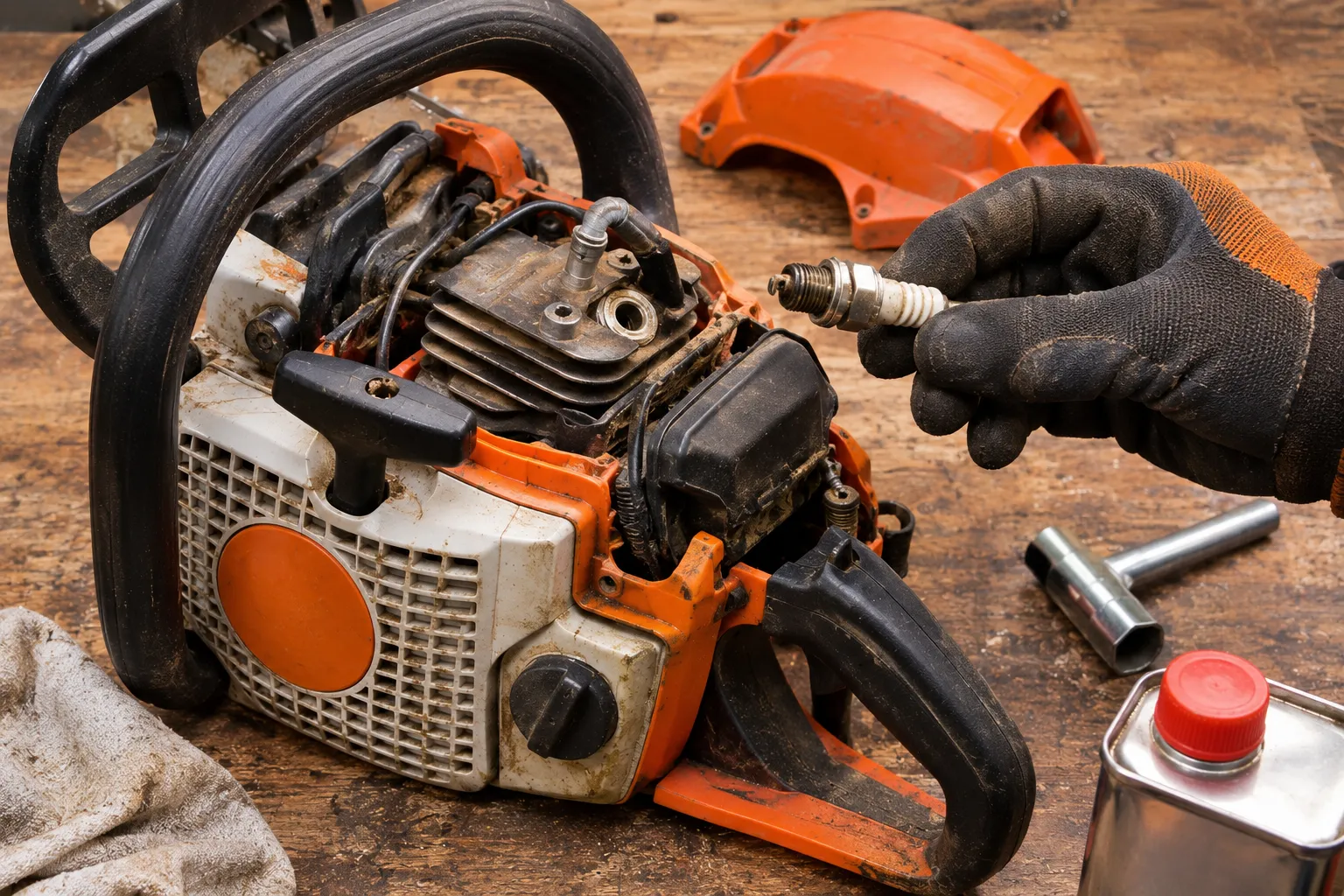
Pull the plug and look at it. Per Echo’s CS-310 manual, a plug covered in carbon should be cleaned or replaced. Husqvarna’s manual page says a dirty plug should be cleaned and the gap checked.
| Plug look | Meaning |
|---|---|
| Light tan, dry | Normal |
| Black and sooty | Rich mix, a dirty filter or the wrong oil |
| Wet with fuel | Flooded, or fuel is not igniting |
| White, blistered or melted | Running lean. Stop and see a dealer |
| Cracked porcelain or worn electrodes | Replace |
Gap varies by model: 0.5 mm (0.020 inch) in several Stihl manuals and a Husqvarna 455 Rancher manual, and 0.65 mm (0.026 inch) for an Echo CS-310. Husqvarna says to bend the ground electrode lightly and measure again. A cheap new plug of the type your manual lists is often the quickest test. Stihl says to ask a dealer for the right plug, since not every NGK plug is the same.
If a fresh plug gives no spark, a failed ignition coil or kill switch is possible. That is dealer work.
Step 5: Air filter
A clogged filter can stop a saw from starting or running. Echo’s manual lists a plugged filter as a cause of a no-start. Remove it and try again, then clean or replace it. Steps by filter type are in how to clean a chainsaw. Do not run without a filter for long.
Step 6: Fuel filter and lines
Husqvarna says that a saw which stalls when tilted may have a fuel filter that has come out of the fuel, and that the filter, lines and fittings should be present and undamaged. Stihl’s maintenance chart lists the pickup body, or filter, in the tank.
- Look in the tank with a flashlight. A dark, stiff or missing filter should be replaced.
- Check the fuel lines and the primer bulb for cracks, hardening and leaks.
- Check the fuel cap vent. Owners report that a blocked vent makes a saw run, then die. Husqvarna’s page does not list it, so treat it as a forum finding.
Line leaks or damage go to a dealer, per Husqvarna.
Step 7: Spark arrestor screen
Husqvarna says a clogged screen can make the saw stall. Let the muffler cool, remove the screen, brush it with a soft brush, and refit it. Replace it if damaged.
Step 8: Carburetor
If fuel, air and spark are fine, the carburetor is next. Old fuel leaves varnish and sticky diaphragms, which is the reason Stihl gives for running a saw dry before storage. Rebuild and adjustment are dealer jobs for most owners. The idle and mixture screws can melt a piston if set lean, which forum posts repeat, so do not turn them on a hunch.
When to take it to a dealer
- A pull cord with no resistance, or one that is locked after you have removed the plug.
- Weak or uneven compression: the cord pulls too easily, or the saw never fires after fuel, air and spark are all fine.
- Scoring or damage on the piston or cylinder wall, which you can see through the plug hole or exhaust port.
- Fuel leaking from somewhere other than the cap.
- No spark with a new plug.
- A white, melted-looking plug.
Husqvarna also says a saw damaged by old fuel should go to an authorised dealer.
Battery saws that will not run
| Check | Detail |
|---|---|
| Charge and seating | Reseat the battery. Charge it. |
| Temperature | Husqvarna’s BLi-X 36 V works from 14 to 104 degrees F in the air, and will not charge below 32 degrees F. Stihl red lights can mean a battery too hot or too cold |
| Chain brake | Several Stihl cordless manuals say to disengage the brake before restarting |
| Overload | Heat and overload cutouts shut the saw off. Husqvarna says to reduce the load when the temperature light flashes, and the tool shuts down at an internal 158 degrees F |
| Dampness | Some Stihl manuals list a wet saw or battery, which should dry out first |
Stihl’s cordless manuals describe a red light pattern. In general one light points to battery heat, cold or low charge, three means the saw is too hot, and four flashing means a battery fault. The meaning varies by model. In any of them, engage the brake, remove the battery and let the part cool or warm up. If a fault stays, stop using it and see a dealer. Do not try to defeat the protection. It protects the motor, the battery and you.
Bottom line
Fresh fuel, correct choke, a clean plug and clean filters fix most saws. Work through the steps in order, stop when it runs, and leave scored pistons, weak compression and ignition faults to a dealer. For battery saws, think temperature, charge, brake and load. Our starting guide and maintenance checklist help prevent a repeat.
Common questions
Why won't my chainsaw start after sitting all winter?
Old fuel is the most common cause. Stihl says standard pump gasoline should not be kept more than 30 days, and Husqvarna warns that stale fuel can clog the fuel system and is not covered by warranty. Drain the old fuel, mix fresh, and check the plug and filters before suspecting the carburetor.
How do I start a flooded chainsaw?
Husqvarna's support page says to place the saw on the ground, hold the throttle wide open and pull until it fires, expecting some coughing. Other guides add removing the spark plug, drying it and pulling the cord several times to clear the cylinder. Check your manual. If the cord will not pull at all, stop and see below.
Why does my chainsaw start and then die?
Husqvarna lists stale fuel, a fuel filter that has come loose or clogged, a dirty air filter and a clogged spark arrestor. Owners also report a blocked fuel cap vent and a carburetor that needs cleaning. Start with fresh fuel, then work through the filters.
What is the spark plug gap for a chainsaw?
It varies by model. Stihl manuals for several saws list 0.5 mm (0.020 inch), a Husqvarna 455 Rancher manual lists 0.5 mm, and an Echo CS-310 manual lists 0.65 mm (0.026 inch). Use the figure in your own manual.
My battery chainsaw will not run. What should I check?
Check that the battery is charged and seated, that its temperature is within the maker's range, that the chain brake is released, and that you are not overloading the saw. Stihl and Husqvarna both use warning lights for heat and overload, and both tell you to stop and let things cool.