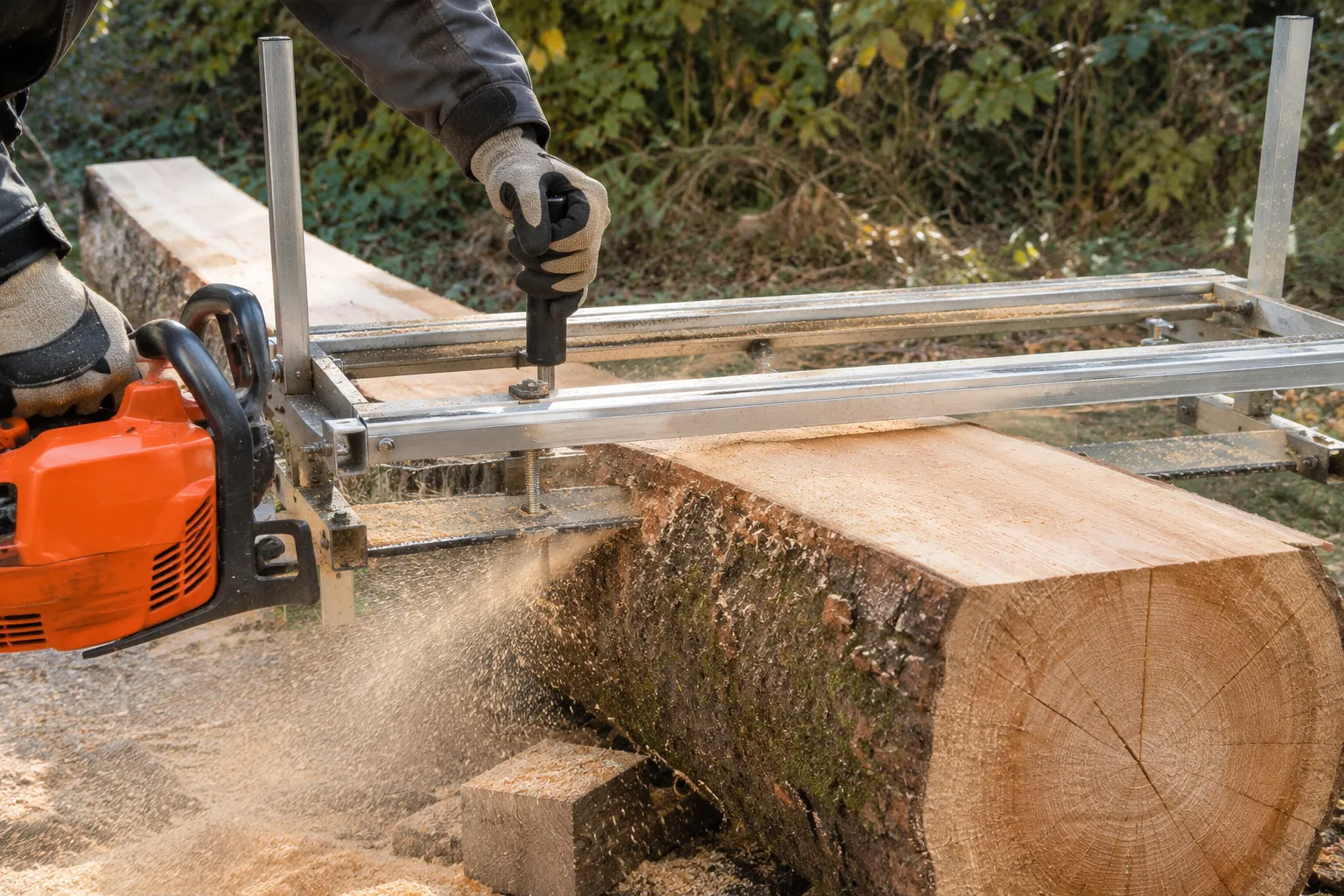
A chainsaw mill is a frame that clamps onto your guide bar and turns the saw into a small sawmill. It lets you cut boards, beams and slabs from a log where it fell, for a fraction of the cost of a bandsaw mill. For a homeowner with a few good logs and a big enough saw, it is the cheapest way into lumber making.
There are three kinds of tool sold under the name. Slabbing mills, the classic Alaskan style, hold the bar flat and slice boards off the log. Edging mills hold the bar upright to square the sides. Rail systems give either one a straight line to follow.
This guide covers all three, based on manufacturer specifications, retailer listings and published reviews, not on our own testing. Prices are approximate and were checked in November 2026.
Quick comparison
| Mill | Type | Bar length | Approx. price | Best for |
|---|---|---|---|---|
| Granberg Alaskan MK-IV G778-36 | Slabbing mill | Up to 36” | $240 to $295 | Most people |
| Granberg Alaskan Small Log Mill G777 | Slabbing mill, single clamp | 16” to 20” | About $175 | Small saws and small logs |
| VEVOR 14” to 36” chainsaw mill | Slabbing mill, budget | 14” to 36” | $58 to $78 | Trying milling cheaply |
| Granberg Edging Mill G555B | Vertical edging mill | Varies by listing | $135 to $185 | Squaring logs into beams |
| Timber Tuff TMW-56 | Vertical cutting guide | Any | $34 to $53 | Occasional beams and posts |
| Granberg EZ Rail G1010 | 10 ft rail system | Not applicable | $270 to $300 | Straight first cuts |
1. Granberg Alaskan MK-IV G778-36: best overall
The Alaskan mill is the design every other slabbing mill copies, and the MK-IV is Granberg’s current version. The 36” model clamps to the bar at both ends, cuts boards up to 32” wide and from 1/2” to 13” thick, and weighs about 20 pounds according to retailer listings. Bob Vila named it Best Overall in its roundup of chainsaw mills.
Granberg sells the same mill in other rail lengths, including 24”, 30” and 48”, and larger sizes up to 72”. The 36” is the practical choice for most home millers: it fits the bars that 70 to 90 cc saws can pull, and you can run a shorter bar in it if you need to. Prices for the 36” kit range from about $240 to $295 depending on the retailer.
Good
- Clamps at both ends of the bar for a stable, even cut
- Wide thickness range, from 1/2” to 13”
- Sold in many sizes, with replacement parts available
- Fits any brand of saw without drilling the bar
Not so good
- Costs three to four times as much as a clone
- Needs a 70 cc or larger saw to use its full width
- First-cut rail or guide board is not included
Buy it if you plan to mill more than a log or two and want a mill that will stay square and can be repaired.
2. Granberg Alaskan Small Log Mill G777: best for smaller saws
The Small Log Mill is built for bars from 16” to 20”. It clamps to the bar at the powerhead end only, which leaves the nose free and makes it quick to fit. Bob Vila lists its capacity as boards up to 18” wide and 1/2” to 13” thick, and retailers put the weight at 10 to 11 pounds.
Bailey’s and Zoro both give 50 cc as the starting point for this mill, which puts it within reach of a mid-size firewood saw. Zoro lists it at about $175. If your saw is in that range and your logs are modest, this is the right first mill. For help choosing a powerhead, see our guide to the best chainsaw for milling lumber.
Good
- Works with 50 cc and larger saws and 16” to 20” bars
- About half the weight of the 36” mill
- Fast to mount and remove
- Same build quality as the larger Alaskan mills
Not so good
- Limited to boards about 18” wide
- With a single clamp, the free end of the bar can wander if you push hard
- Not much cheaper than a full-size clone
Buy it if you own a 50 to 70 cc saw with a 20” bar and want to mill small logs without buying a bigger powerhead.
3. VEVOR 14” to 36” chainsaw mill: best budget clone
Dozens of low-cost mills copy the Alaskan layout, and VEVOR’s is one of the most widely sold. It adjusts to fit bars from 14” to 36” and is built from steel and aluminum. Listings disagree on the thickness range, with some giving roughly 0.2” to 11.8” and one VEVOR page giving 1/2” to 13”, so check the listing you buy from.
The price is the appeal. The standalone mill is listed at about $58 to $78, and a bundle with a 9 ft aluminum rail runs roughly $117 to $142. That is less than the Granberg mill alone. At this price, expect to spend time squaring the frame during assembly and to check the bolts often.
Good
- Very low price
- One frame adjusts from 14” to 36” bars
- Available bundled with a rail for the first cut
Not so good
- Specifications vary between listings
- Finish and hardware are a step below Granberg
- Parts support is uncertain
Buy it if you have one or two logs to mill and want to find out whether you enjoy it before spending more.
4. Granberg Edging Mill G555B: best vertical mill
The G555B, long sold as the Mini Mill, holds the saw with the bar vertical and rides along a V-shaped rail that you fasten to the log. It is used to square the sides of a log into a cant or beam, or to trim the edges of slabs. Paired with an Alaskan mill it lets you produce square-edged lumber.
It is made of aircraft aluminum and zinc-plated steel, weighs about 7 pounds, and comes with 12 feet of V-rail in 2-foot sections along with screws and nails to mount it. Listings disagree on bar length, so confirm fit for your saw before ordering. Prices run from about $135 to $185, and a few retailers show it as special order.
Good
- 12 feet of guide rail included
- Light and simple to set up
- Squares logs that are too heavy to turn easily
- Complements a slabbing mill
Not so good
- The bar is supported at one end only, so cuts need a steady hand
- Availability varies by retailer
- Not a replacement for a slabbing mill
Buy it if you want beams, posts or square-edged boards and already have, or plan to buy, a slabbing mill.
5. Timber Tuff TMW-56: cheapest way to cut a beam
The Timber Tuff Lumber Cutting Guide is a small steel bracket that clamps to the bar and slides along a 2x6 board fastened to the log. It weighs about 3 pounds and fits any chainsaw. Bob Vila picked it as Best for Beginners.
Prices range from about $34 to $53. That makes it the cheapest tool in this guide by a wide margin. It is for squaring a log into a post or beam, or for rough planks, not for clean, even boards. Published owner reviews are mixed on build quality, and at least one retailer lists it as discontinued, so availability may vary.
Good
- Very inexpensive
- Fits any saw and bar
- Small enough to keep in the truck
Not so good
- Accuracy depends on your guide board and your hands
- Mixed owner reviews
- You supply the 2x6
Buy it if you need a few posts, beams or rough planks and do not want to invest in a full mill.
6. Granberg EZ Rail G1010: best rail system
The first cut decides how flat every later board will be. Many people screw a ladder or a straight plank to the log, which works. A purpose-built rail is faster to set up and easier to keep straight. Granberg’s EZ Rail G1010 is a 10 ft aluminum rail that ships in two 5 ft sections, with crossbar kits that hold it level on the log. Granberg also sells a 5 ft extension for longer logs.
Listings for the 10 ft system range from about $270 to $300, which is more than the mill it guides. Third-party 9 ft rails are sold for much less, VEVOR’s among them at around $90, and are a reasonable option on a budget.
Good
- Straight, repeatable first cuts
- Breaks down into 5 ft sections for transport
- Extendable for longer logs
Not so good
- Costs as much as a mill
- A ladder or plank does the same job for occasional use
- One more thing to carry into the woods
Buy it if you mill often and are tired of improvising a guide for every first cut.
How to choose a chainsaw mill
Match the mill to your saw first
A mill is only as capable as the saw driving it. A 36” mill on a 55 cc saw will be slow and hard on the engine. As a rough guide:
- 50 to 60 cc, 16” to 20” bar: a small log mill.
- 70 cc and up, 24” to 36” bar: a 30” or 36” Alaskan-style mill.
- 90 to 120 cc, 36” bar and longer: a 36” or 48” mill.
Know your real cutting width
The clamps take up bar length. A 36” mill cuts about 32” wide, and a mill for 20” bars cuts about 18”. Measure your logs at the widest point, not the average.
Decide whether you need square edges
A slabbing mill alone gives you live-edge boards. If you want dimensional lumber or beams, add an edging mill or plan to rip the edges later with a circular saw or track saw.
Plan the first cut
Every slabbing mill needs a flat reference for the first pass. Budget for a rail, or prepare a straight plank or ladder and a way to fasten it level.
Use ripping chain and keep it sharp
Ripping chain, ground at about 10 degrees, leaves a smoother surface than standard chain. Milling dulls any chain quickly, so sharpen often. Our chainsaw sharpener guide covers the options.
A word on safety
Wear chaps, eye and hearing protection, gloves and boots. Milling throws a lot of fine dust and keeps you beside the saw for long cuts. Block the log so it cannot roll, keep the bar nose clear of anything behind the cut to avoid kickback, and drive wedges into the kerf on long cuts so the slab does not pinch the bar.
Bottom line
The Granberg Alaskan MK-IV G778-36 is the best chainsaw mill for most people: it clamps at both ends, cuts up to 32” wide, and is supported with parts. Choose the Granberg Small Log Mill G777 if your saw is under 70 cc, or the VEVOR clone if you only want to try milling. Add the Granberg Edging Mill G555B when you want square timbers.
Common questions
What size chainsaw mill do I need?
Match the mill to your bar and your logs. A mill sized for a 36 inch bar cuts boards up to about 32 inches wide, because the clamps take up a few inches of bar. If your logs are under 18 inches across, a small log mill on a 20 inch bar is lighter and cheaper.
How big a chainsaw do I need to run a chainsaw mill?
Retailers list 50 cc as the minimum for Granberg's smaller mills, and Bailey's suggests at least 60 cc. For the 36 inch Alaskan mill, Granberg recommends 70 cc or more according to Bob Vila. More displacement means faster cuts and less strain on the saw.
Are budget chainsaw mills any good?
They follow the same basic design as the Granberg Alaskan mill and will cut boards. The usual trade-offs are rougher finishing, hardware that may need replacing, and instructions that leave a lot to work out. They are a low-cost way to find out whether milling is for you.
Do I need a guide rail for the first cut?
Yes. A slabbing mill rides on a flat surface, and a round log has none. For the first cut you need a straight reference on top of the log, such as a rail system, a straight plank or an aluminum ladder screwed down. After that the mill rides on the flat face you just cut.
What is the difference between a slabbing mill and an edging mill?
A slabbing mill, often called an Alaskan mill, holds the bar horizontal and cuts boards off the top of the log. An edging mill holds the bar vertical and follows a rail, which is used to square a log into a beam or trim the edges of slabs.